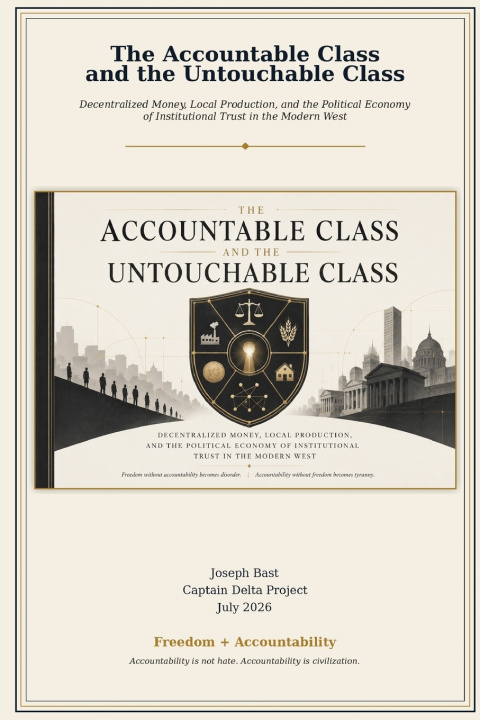
This book-format version of the paper, The Accountable Class and the Untouchable Class, argues that the central crisis of the modern West is the growing separation between power and accountability. Rather than framing today's instability only through left versus right, rich versus poor, public versus private, or native-born versus immigrant, the book proposes a different political-economic divide: the accountable class and the untouchable class.
The accountable class includes the people who bear direct consequences: workers, tradespeople, small business owners, farmers, parents, taxpayers, renters, homeowners, savers, lawful immigrants, and local communities. The untouchable class refers to institutions, networks, and authorities that exercise power while often avoiding proportional consequence: governments, bureaucracies, central banks, major financial institutions, corporations, digital platforms, crisis industries, selective legal systems, protected narratives, and criminal networks that exploit weak enforcement.
The core thesis is that civilization depends on the union of freedom and accountability. Freedom without accountability becomes disorder; accountability without freedom becomes tyranny. A healthy society requires both.
The book examines how inflation functions as a hidden tax on stored labour, how Bitcoin and hard-money alternatives represent rule-based monetary exit, how taxation can become extraction when public return disappears, and how selective enforcement undermines trust in law. It applies the accountability framework to immigration, arguing for clear legal categories, genuine refugee protection, lawful borders, enforceable removals, and rejection of collective blame.
It also analyzes corporate power, surveillance, software locks, subscription models, and repair restrictions as ways modern citizens are transformed from owners into managed users. In response, the book develops an ownership-based alternative built around right-to-repair, micro-manufacturing, local workshops, open-source hardware, small-scale farming, household food production, food preservation, and personal ownership of money, tools, skills, data, health, time, family responsibility, and community.
The proposed model is not anti-government, anti-market, or anti-technology. It accepts the need for law, public institutions, trade, corporations, and innovation, but insists that all power must be bound by consequence. Its governing principle is "freedom plus accountability": equal law, transparent data, honest money, meaningful ownership, speech freedom, secure borders, institutional consequence, local production, and citizens capable of practical self-government.
Ultimately, the book argues that the West must choose between a managed society of dependent users and an ownership society of responsible citizens. Its final claim is simple: accountability is not hate; accountability is civilization.