The technology arrived. The advantage did not.
Across the life-sciences industry, the pattern repeats. Companies buy the AI platforms, hire the data scientists, run the pilots, and stand up the committees yet still cannot answer the only question that matters: is any of this getting medicines to patients faster, or decisions made sooner?
In The Adaptive Pharma Enterprise, transformation coach Sekhar Burra argues that the missing ingredient was never more technology. AI does not transform an organization, it exposes one. What separates the leaders pulling ahead is adaptiveness: the capacity of the whole enterprise to sense change, decide quickly, and reconfigure itself without sacrificing the rigor that keeps patients safe.
This is a practitioner's playbook for turning uncertainty into strategic optionality building an organization that can pivot a trial, redirect investment, redeploy talent, and scale a capability faster than its circumstances change. And it directly confronts the industry's most expensive misunderstanding: that "we're regulated" is a reason not to move. Adaptiveness and regulatory rigor are not opposites. They are allies.
Grounded in the real world of discovery, clinical development, manufacturing, quality, and commercialization, the book delivers a complete operating system:
- A model of the adaptive leader, team, and culture because no operating model survives leaders who haven't changed themselves
- The six-capability Adaptive Pharma Operating System, from networked decision rights to regulatory and quality agility
- The Adaptive Pharma Scorecard and Optionality Index measuring what actually matters, not just activity
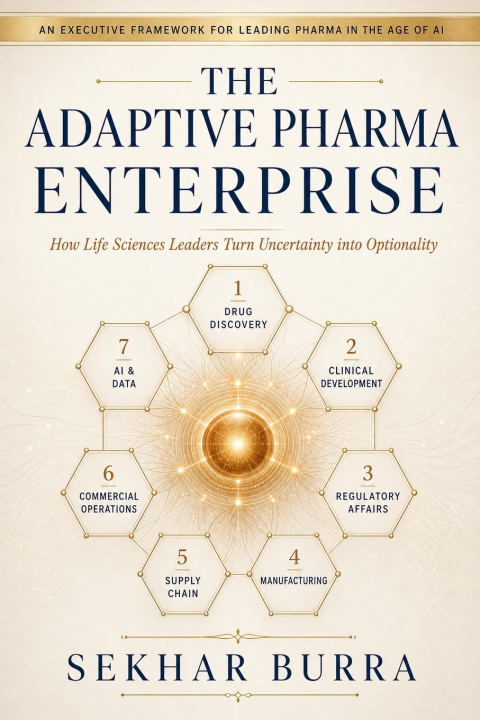
- Adaptiveness applied across the entire value chain, from the first spark of discovery to the patient waiting at the end of it
- A practical diagnostic, a roadmap, and a clear-eyed guide to the transformation traps that sink most efforts
Every chapter closes with reflection questions and a quiz, and the appendices turn the core tools into instruments a team can use on Monday morning.
For CEOs, and the heads of R&D, clinical, regulatory, manufacturing, and commercial and for every director and manager carrying the real weight of change this is the framework for leading pharma in the age of AI.
The distance between a discovery in a laboratory and a patient waiting for it is measured in days. Adaptiveness is how you close it.