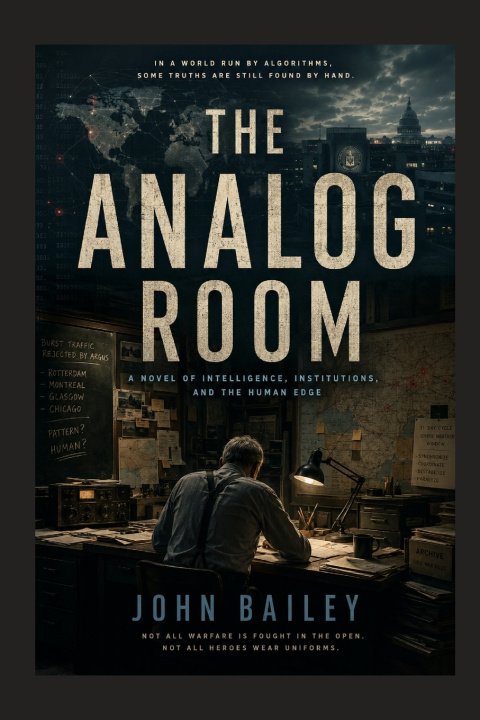
The elevator didn't go down to Sub-Level C.
That was the first thing people learned when they joined the Hargrove Federal Intelligence Complex. The second thing they learned was that almost nobody needed to go there.
Daniel Mercer needs to go there every morning.
For eleven years, Mercer has run the Signals Analysis and Historical Reference office - a department so forgotten it isn't worth a proper termination, only a cleanup assignment before the budget review closes it for good. His team of four aging analysts occupies a basement that smells of old paper and machine oil, working with pencils, legal pads, and a shortwave receiver that should have been retired decades ago.
Above them, ARGUS - the most advanced intelligence processing system ever built - analyzes forty-seven thousand signals a day and misses every single one of the messages Mercer is beginning to find.
Because someone has spent thirty years teaching it not to look.
What Mercer uncovers in a batch of discarded signals is not a glitch, not coincidence, and not the product of an old man desperate to feel useful. It is a network of extraordinary patience and discipline, built from the remnants of a Cold War doctrine and adapted with surgical precision for the age of artificial intelligence - a network that has learned to look exactly like everything that can be safely ignored.
As a NATO summit approaches and the cascade of small failures begins to accelerate, Mercer's team must build the case and stop the operation using the only tools they have left: attention, experience, and the stubborn conviction that what they know is still worth knowing.
The Analog Room is a novel about the things we automate out of our systems - and what happens when we need them back.