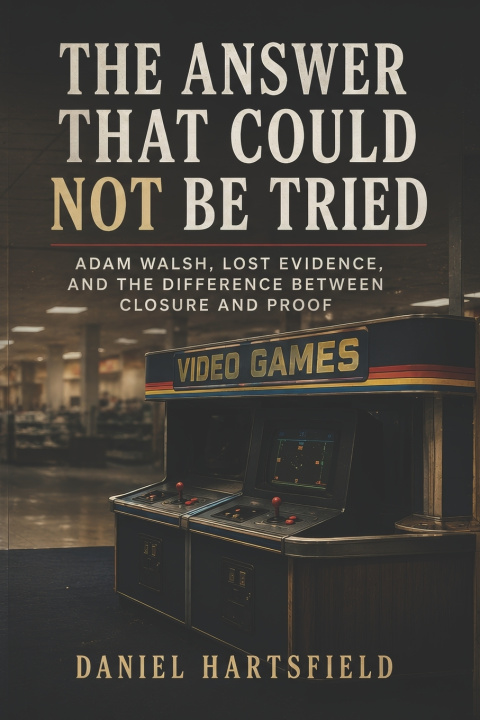
A case can be officially closed and still never be tested in court.
On July 27, 1981, six-year-old Adam Walsh disappeared from a department store at Hollywood Mall in Hollywood, Florida. Two weeks later, partial remains identified as Adam's were recovered more than one hundred miles away. The investigation became one of America's most consequential missing-child cases-and one of its most difficult examples of the distance between an official answer and courtroom proof.
The Answer That Could Not Be Tried follows the Adam Walsh case through the surviving public record: the ordinary store where Adam was last known to be, the first missing hours, the road north to the recovery site, the early investigative dead ends, and the statements that later drew police toward Ottis Elwood Toole. Toole reportedly confessed, recanted, changed details, and supplied both apparently significant information and false pieces. He was never charged, tried, or convicted in Adam's abduction or death.
At the center of this historical true crime investigation is the evidence that might have tested the official theory. A white Cadillac became a possible bridge between the store and the recovery site. Reported blood evidence in its carpet raised questions that later science might have answered, but the material did not survive in usable form. A machete remained suggestive rather than conclusive. A late witness added weight while also carrying the limits of memory, publicity, and time.
The book examines why confession is not the same as corroboration, why chain of custody matters, and how lost or mishandled evidence can prevent suspicion from becoming a prosecutable case. It also considers the alternative names that entered public discussion without allowing notoriety, speculation, or retrospective certainty to substitute for proof.
In 2008, Hollywood police administratively closed the case and publicly identified Toole as responsible. By then, Toole had been dead for more than a decade. The department could state its investigative conclusion, but no defense could cross-examine witnesses, no jury could weigh the contradictions, and no court could decide whether the burden of proof had been met.
Adam's case also changed the national response to missing children, shaped advocacy, and exposed how unprepared institutions could be when a child vanished from an ordinary public place. Yet this narrative keeps the child before the symbol, the family before the public legacy, and the human loss before the systems built afterward.
Written in a restrained, evidence-aware style, The Answer That Could Not Be Tried is for readers of historical true crime, missing-child investigations, forensic evidence cases, and criminal justice history. It follows what is confirmed, identifies what is reported or disputed, and preserves the unknowns that the surviving record cannot honestly resolve.
Enter the evidence room, the damaged archive, and the narrow but essential space between closure and proof.