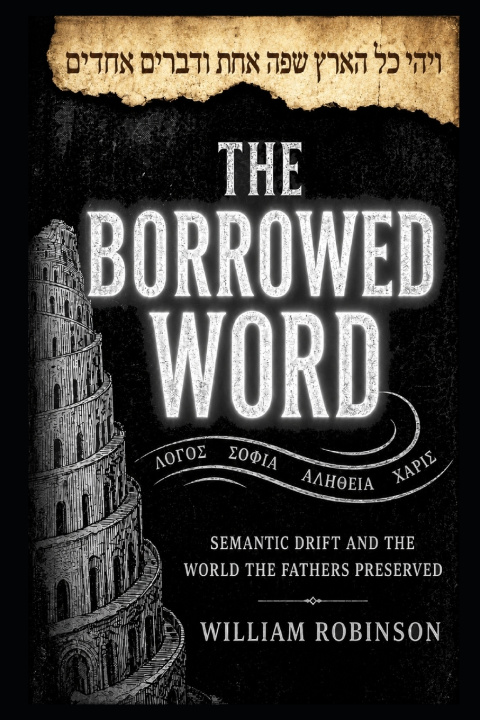
Say the word Christian, and it may call up many associations.
For some, it awakens the wound of hypocrisy: assent to ideas about God without being formed by Him. That is not the fullness of Christian life. Borrowed faith may repeat the right words, but living faith passes through humility, struggle, and participation. The deeper it grows, the less it circles the self and the more it is gathered into God.
Something has gone quiet in modern Christianity.
The words are still there: grace, salvation, faith, church, person, spirit, God, even Christian. But for many sincere believers, they have begun to feel thin. They are true words, yet the world they once opened has grown distant. The name Christian is still spoken through inherited assumptions and private meanings that no longer share one living grammar.
This book names why.
The Borrowed Word traces how Christian vocabulary drifted from its original world. Scripture did not arise inside a flat religious vocabulary. It came from a world where heaven and earth were ordered under YHWH, where the sons of God and powers of the nations, when fallen into rebellion, revealed a deeper disorder: representation turning into self-reference, service into possession, and worship into self-worship. Israel's prophets bore witness to the One Most High, whose Name gives being, judges false powers, and calls all things back to their proper end.
These realities were carried into Greek by the Fathers, who used philosophical language without surrendering the biblical world it served. But through translation, controversy, empire, legal habit, and modern abstraction, the grammar changed. Verbs became nouns. Adverbs of participation became static categories. Healing, illumination, obedience, and communion became concepts about God rather than ways of being opened to God. Access narrowed as participatory use was replaced by speculation without engagement.
By the time many modern Christians received the faith, they inherited true labels attached to narrowed meanings. The words remained. Their world grew distant.
When continuity is lost, progress can be guided by self-reacting, rather than sharing in the Humility of Christ. The people of God may keep moving, yet still circle in the wilderness, hearing fragments of the Word while struggling to recognize the way into the city.
The result is fragmentation many believers sense but cannot locate: salvation as legal transaction rather than healing, grace as distance rather than communion, the Trinity as arithmetic rather than living grammar, and doctrine as tribal identity rather than protective wisdom.
With the early Church Fathers, this book shows what was preserved in the older tradition and why it matters now.
The purpose is not to gather attention around us, our school, or our party, but to glorify the Name of YHWH by recovering the grammar of participation: Salvation, Victory, Word, Angel of the Lord, Spirit, Presence, Faithfulness, and the yoke by which human nature learns to answer God again. These are living references within the counsel of God, harmonies of the one divine economy, and participated synergies by which creation is taught to bear witness.
The Borrowed Word is for the Christian who loves Scripture and Jesus but senses that modern categories cannot fully explain what Scripture keeps promising. It is a diagnosis, a history, and an invitation to hear the familiar words again within their proper world, to turn back with humility toward those who sought the same aim, and to recover the disciplines of a disciple.
This is not novelty. It is restoration. It is a call to hear the Word in the wilderness, to share in Christ's self-emptying through death, humility, and new life, and to walk with God by synergy rather than grasping. There, human nature is not erased but healed, yoked to His faithfulness, and made to shine with a life it could never generate alone.