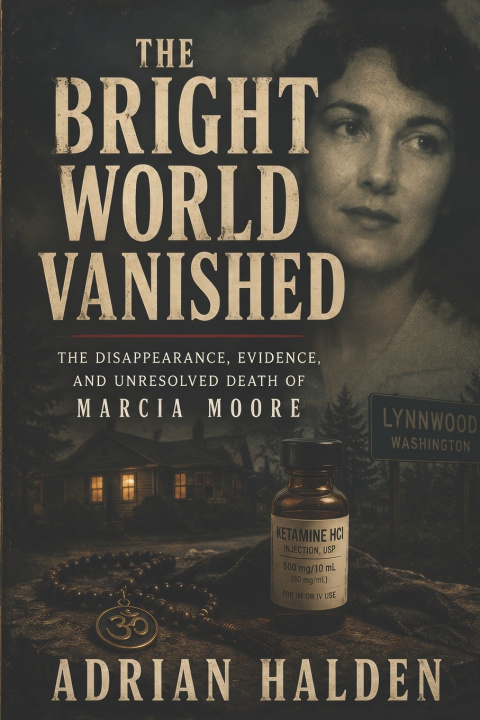
A missing woman. A damaged record. A true crime case that still resists certainty.
The Bright World Vanished is an evidence-aware true crime investigation into the disappearance and unresolved death of Marcia Moore, a writer, mother, spiritual seeker, and public figure whose final years became entangled with ketamine, suspicion, and myth.
In January 1979, Moore vanished from the Washington world she shared with her husband, anesthesiologist Howard Alltounian. For two years, her absence left room for competing explanations: misadventure, suicide, homicide, drug-related risk, and spiritualized rumor. When partial remains were later recovered, they confirmed death but did not settle the central question of what happened.
This book follows the case through what can be responsibly examined: Moore's life before the headlines, her writing on altered states and metaphysical experience, the household context, the search, the condition of the evidence, and the later claims that kept suspicion alive. It treats ketamine as a meaningful part of the case without allowing the drug to become an automatic explanation.
Rather than presenting suspicion as a verdict, The Bright World Vanished separates confirmed fact from allegation, inference from proof, and public memory from the documented record. The book considers why homicide cannot be dismissed casually, why accident and suicide theories remain difficult to close, and why unsupported occult or paranormal theories reveal more about public fascination than evidence.
At its center, this is not only a cold case book. It is a study of how an unusual victim can be misunderstood: as an heiress, a mystic, a ketamine figure, or a headline, rather than as a person whose disappearance deserved disciplined attention. The investigation asks what happens when a missing persons case is shaped by early assumptions, incomplete forensic evidence, and the stories others tell after the victim can no longer speak.
Written in a restrained investigative style, this true crime nonfiction account is for readers interested in unsolved cases, missing persons, forensic uncertainty, historical true crime, and the ethics of unresolved death. It does not promise certainty where the record does not support it. It follows the evidence, the limits, and the questions that remain.