Most COBOL migration projects don't fail because the AI writes bad code.
They fail because organizations mistake translation for modernization.
An LLM can convert COBOL into Java, C#, or Python in minutes. What it cannot do is prove behavioral equivalence, preserve decades of undocumented business rules, guarantee production safety, or satisfy regulatory audits.
That is where million-dollar modernization programs succeed, or collapse.
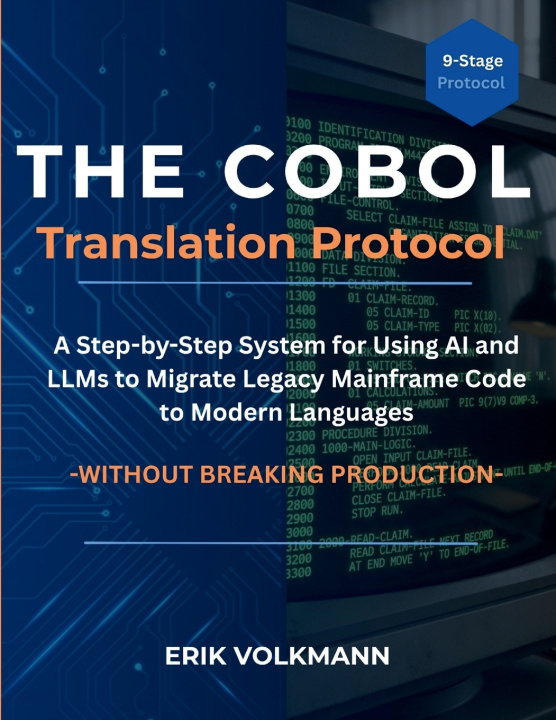
If you're responsible for migrating legacy systems, this book gives you something vendor demos never will: a complete engineering methodology for AI-assisted COBOL modernization.
Instead of chasing the latest AI tool, you'll learn how to build a repeatable, auditable, and tool-agnostic migration process that works whether you're using Claude Code, IBM watsonx Code Assistant, Amazon Q, GitHub Copilot, or the next generation of AI platforms.
Inside this practical implementation guide, you'll learn how to:
- Distinguish code translation from true enterprise modernization
- Build a complete inventory of COBOL applications, copybooks, JCL, and datasets before migration begins
- Discover hidden dependencies and undocumented business logic using AI and structured analysis
- Classify applications for rehosting, refactoring, rewriting, or retirement using a proven risk-based framework
- Evaluate AI migration tools beyond marketing claims using practical engineering criteria
- Design a behavioral equivalence strategy that proves migrated applications produce the same business outcomes
- Build automated validation pipelines with characterization testing, differential testing, and production shadow runs
- Protect mission-critical systems with rollback planning, observability, governance, and audit-ready evidence
- Modernize legacy applications incrementally while minimizing operational risk and downtime
- Create an enterprise migration program that scales across hundreds or thousands of COBOL applications
Unlike books that focus on prompts or AI features, this guide introduces the
COBOL Translation Protocol, a comprehensive modernization framework built on five non-negotiable engineering principles:
- Behavioral Equivalence
- Reversibility
- Incremental Delivery
- Observability
- Governance
Packed with practical checklists, decision frameworks, migration workflows, implementation templates, evaluation criteria, risk models, and production-ready best practices, this book equips architects and engineering leaders with a methodology they can apply immediately inside real modernization programs.
Whether you're a software architect, modernization consultant, mainframe engineer, engineering manager, enterprise architect, CTO, or technology leader planning your organization's legacy transformation, this book will help you replace uncertainty with a disciplined, evidence-driven migration process.
AI can translate COBOL.Engineering discipline is what modernizes it.If your organization cannot afford migration failure, this is the playbook you'll want on your desk before the first line of code is converted.