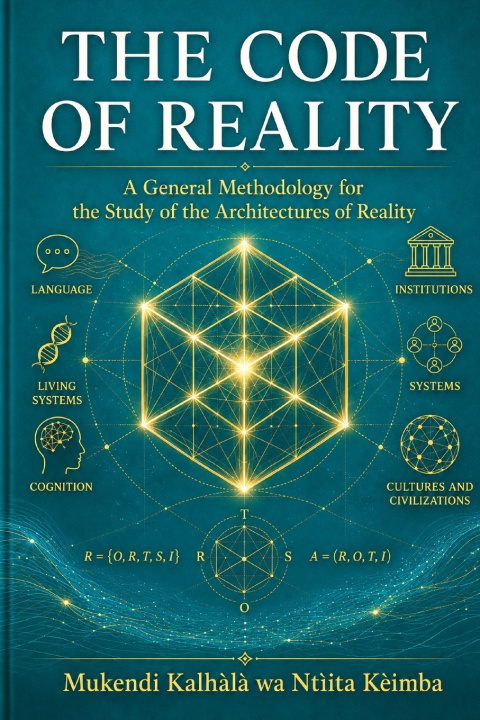
What if reality possessed a common architecture?
Why do comparable patterns of organization seem to recur across domains as diverse as language, living systems, cognition, institutions, cultures, and civilizations? Are there organizing principles sufficiently general to be identified, compared, and studied through a common methodology-without diminishing the distinctive nature of each discipline?
In The Code of Reality, Mukendi Kalhàlà wa Ntììta Kèimba offers an original answer to these questions by developing a general methodology for the study of the architectures of reality. Rather than proposing a universal theory of phenomena or seeking to replace established scientific disciplines, the book presents a rigorous methodological framework based on the observation of signatures, the reconstruction of structures, the modeling of architectures, and their comparative validation across independent systems.
The investigation begins with two complementary linguistic laboratories. Cilubà serves as the primary laboratory in which the foundational hypotheses are developed, while Kiswahili provides a second laboratory for their comparative validation. From these linguistic foundations, the inquiry expands to the architectures of living systems, cognition, institutions, cultures, and civilizations, ultimately leading to the formalization of a methodology applicable to the analysis of complex systems across disciplines.
At the heart of this work lies the Cube Kush, introduced not as a cosmology or a symbolic system, but as a metamodel of representation designed to map the orientations, operators, relationships, and transformations that recur across widely different domains of knowledge.
Rigorous in its methodology and ambitious in its scope, The Code of Reality brings together epistemological reflection, comparative methodology, and interdisciplinary perspectives. It is intended for researchers, university lecturers, doctoral candidates, graduate students, and advanced readers interested in linguistics, cognitive science, systems theory, organizational studies, the philosophy of science, artificial intelligence, and transdisciplinary approaches to knowledge.
More than a book about language, The Code of Reality proposes a new way of investigating reality itself-not by beginning with isolated objects, but with the architectures that give them coherence. In doing so, it inaugurates a far-reaching research program designed to foster dialogue among disciplines that have too often evolved in isolation and invites the international scientific community to continue exploring the deep structures that organize reality.