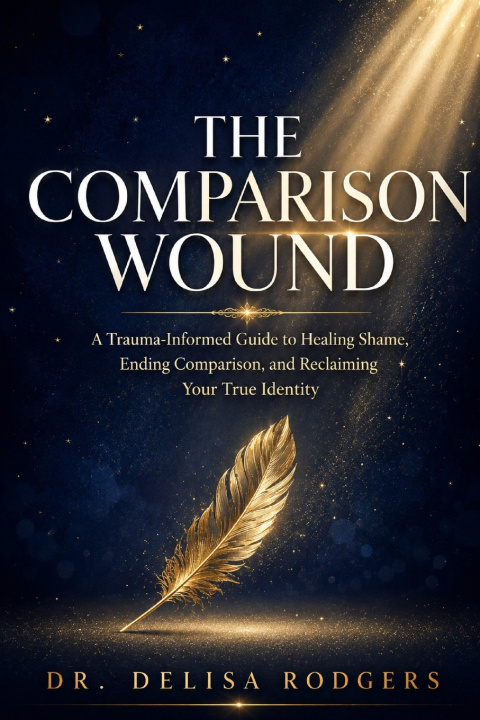
Before many people have the language to name what happened to them, a verdict has already been rendered. They were compared before they were celebrated-measured against another before they could define themselves on their own terms. In response, they learned to perform: to produce more, give more, prove more, attempting to appeal a judgment that was never theirs to carry. The Comparison Wound gives that experience its name.
Drawing from the biblical narrative of Jacob, Leah, and Rachel in Genesis 29 and extending through the full canon, Dr. Delisa Rodgers constructs a rigorous, compassionate, and clinically grounded framework for understanding one of the most pervasive yet least addressed wounds in human development: comparative rivalry. This is not a book about jealousy. It is about the structural conditions that generate jealousy, shame, and performance-based identity-and what it takes to dismantle those conditions at the root.
Integrating apostolic scholarship, trauma-informed practice, and social psychology, Dr. Rodgers weaves together three bodies of knowledge into a cohesive healing model:
• Hebrew lexical analysis of names, identity markers, and transformative moments • Brené Brown's shame resilience research and its application to faith communities • Leon Festinger's social comparison theory and its effects on self-esteem, relationships, and behavior
Core topics include the architecture of comparative wounding; how scarcity-based family and institutional systems create comparison wounds before a child can name them; and why these wounds migrate across generations, congregations, workplaces, and communities. The book outlines two primary wound profiles-the Leah wound and the Rachel wound-each with distinct behavioral signatures and identity distortions. It traces a four-stage healing arc drawn from Leah's journey from Reuben to Judah, showing how internal orientation shifts from striving to settled identity.
Additional themes include shame as an early warning system; how unaddressed shame progresses into jealousy, rage, and self-destruction; intergenerational transmission of comparative wounds; and the theological and psychological case for praise as identity reclamation. Practical tools include wound profile assessments, identity reconditioning exercises, and structured activities for individual or group use.
The Comparison Wound speaks to multiple audiences: individuals who have spent years trying to earn what God already declared; faith-based counselors and trauma-informed practitioners seeking a framework that honors both Scripture and clinical insight; pastors and ministry leaders confronting performance-based identity in their congregations; and those who see themselves in Leah-faithful, productive, and unseen-or in Rachel, possessing what they were told to desire yet still finding it insufficient.
Leah's healing did not come because her circumstances changed. Jacob never stopped loving Rachel. The household never became equitable. What changed was Leah's internal posture-the moment she stopped making her praise conditional on what she would receive and entered a freedom no external condition could revoke. This book invites readers into that same journey: not toward better circumstances, but toward a settled self.