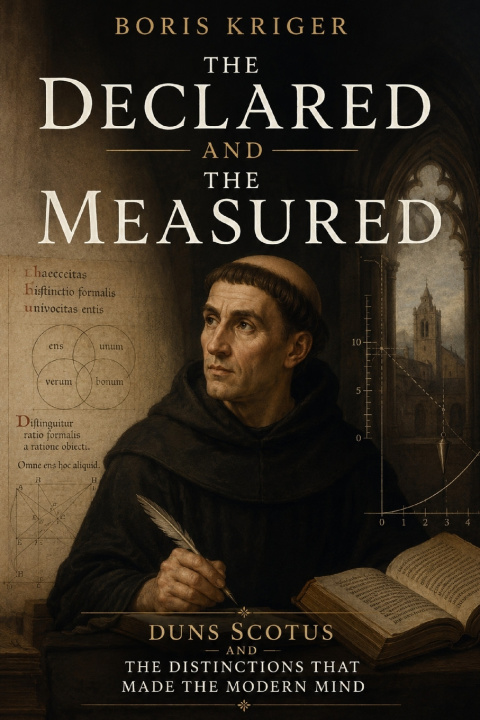
Seven hundred years ago, in a drafty lecture hall, a Franciscan whom everyone had written off as a slow boy picked up the sharpest instrument the medieval mind ever forged and began cutting reality at joints no one else could see. John Duns Scotus lost the great argument of his age to the followers of Thomas Aquinas. Then he quietly won the seven centuries that followed.
This book is about the distinctions he made and why they still decide how we think. It follows one radical claim that holds the whole edifice together - that being is spoken in a single voice across everything that exists, from a speck of matter to the mind of God - and it traces that claim into three of the hardest questions a person can ask. What makes a single thing itself and nothing else? What happens to every conclusion built on a starting point we simply declared to be true? And does the will answer to reason, or reason to the will?
Along the way a surprising modern lesson emerges, one that reaches from a cathedral school straight into today's laboratories, newsrooms, and arguments about the universe: there is a permanent difference between what we measure and what we merely declare, and most of the confidence in the world lives on the wrong side of that line. Duns Scotus saw it first. He even gave us the law that explains why a false premise can prove anything at all.
Written without a single equation, in prose meant to be enjoyed rather than endured, this is the story of a medieval saint that turns out to be a story about you - about the part of you that no profile, no dossier, no complete description will ever capture, and why that stubborn remainder is not a gap in the record but the most solid thing about you.
Keywords: Duns Scotus, medieval philosophy, individuality, free will, scientific method, metaphysics, self-knowledge