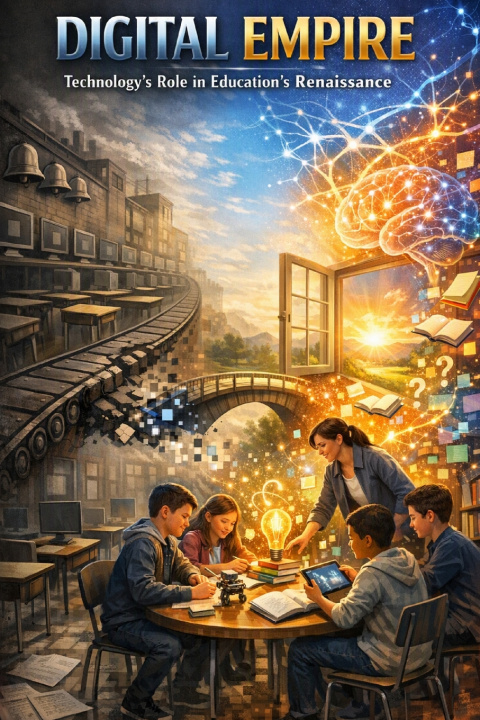
The Digital Empire: Technology's Role in Education's Renaissance is a groundbreaking education reform book that challenges the factory‑model classroom and exposes how modern edtech, standardized testing, and pacing guides have turned learning into compliance rather than curiosity.
Dr. Matthew Irwin, educator, researcher, and author, blends neuroscience, learning science, and classroom innovation to reveal how schools can move from industrial efficiency to authentic engagement. This book is essential reading for teachers, administrators, and education leaders seeking student‑centered learning, critical thinking, and mastery‑based education in the digital age.
Inside you'll discover:
Why factory‑model schooling still dominates-and how to break free.
The neuroscience behind attention, memory, and deep learning.
How to use technology for creativity and collaboration, not compliance.
Practical strategies for assessment reform, inquiry‑based teaching, and authentic engagement.
A step‑by‑step roadmap for transforming your classroom into a thinking laboratory.
Perfect for educators exploring education technology, competency‑based learning, teacher professional development, and classroom transformation, The Digital Empire offers actionable tools to reclaim time for thinking and inspire a new generation of learners.
Keywords: education reform, edtech, classroom innovation, teacher professional development, neuroscience of learning, mastery‑based learning, inquiry‑based teaching, assessment for learning, student engagement, critical thinking, standards‑based grading, education leadership, digital learning, classroom