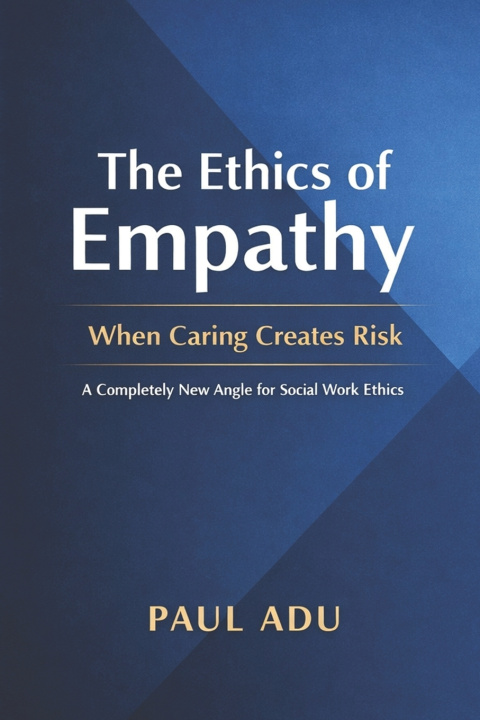
THE ETHICS OF EMPATHY: WHEN CARING CREATES RISK A groundbreaking new angle for social work ethics.
Empathy is celebrated as the heart of social work-but what happens when caring deeply begins to create risk? When emotional connection blurs professional boundaries? When the very qualities that make practitioners compassionate also make them vulnerable?
In THE ETHICS OF EMPATHY, Paul Adu offers a bold and timely re‑examination of one of social work's most cherished values. Drawing on real‑world practice, reflective teaching, and contemporary ethical challenges, this book exposes the hidden tensions that arise when empathy is not only a strength but also a potential liability. It is an essential exploration for practitioners, educators, and students who want to understand empathy not as a simple virtue, but as a complex professional tool that must be used with intention, awareness, and ethical clarity.
This book challenges long‑held assumptions by asking difficult but necessary questions: • What does safe empathy look like in high‑risk environments? • How do practitioners protect themselves emotionally while remaining genuinely present? • When does empathy drift into over‑identification, rescuing, or blurred boundaries? • How can organisations support staff whose caring roles expose them to emotional harm? • What does ethical practice require when empathy becomes professionally dangerous?
Adu introduces a fresh conceptual framework that helps readers recognise the risk‑points of empathy-moments where emotional engagement can compromise judgement, escalate conflict, or create personal vulnerability. Through reflective exercises, practice scenarios, and clear ethical guidance, he shows how social workers can maintain compassion without losing professional grounding.
More than a theory book, THE ETHICS OF EMPATHY is a practical companion for modern social care. It speaks directly to frontline realities: burnout, moral distress, trauma exposure, and the emotional labour that often goes unseen. It empowers practitioners to navigate these pressures with confidence, self‑awareness, and ethical strength.
Whether you are a student preparing for practice, a seasoned professional seeking renewed clarity, or an educator shaping the next generation of social workers, this book offers a transformative perspective. It reframes empathy not as a simple requirement, but as a skill that must be ethically managed, continually reflected upon, and consciously protected.
Empathy is powerful. Empathy is necessary. But empathy-when caring creates risk-must be ethical. This book shows you how.