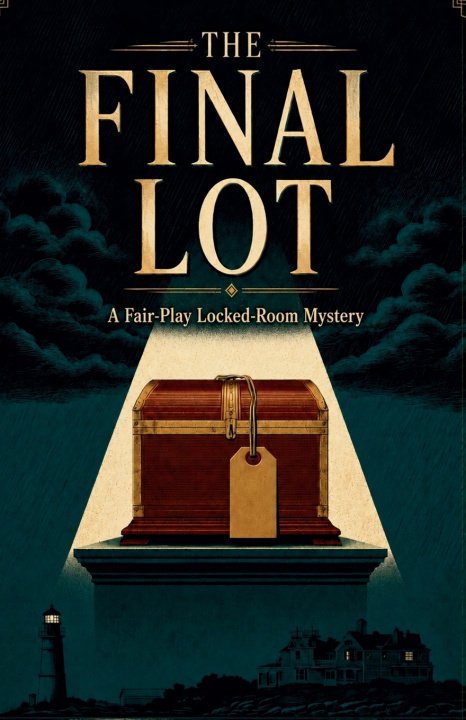
The appraiser was hired to count a dead man's treasures. The dead man was counting on it.
Edmund Marsh - recluse, widower, and collector of "impossible objects" - is found dead inside his private vault, the bolts thrown from the inside, his heart stopped at eighty-one. Natural causes, says the county. Then why, twelve days before he died, did he hire Ambrose Vale - an outside appraiser with a reputation for being thorough to the point of giving offense - to authenticate a collection already tended by the finest conservator on the coast?
By the time Vale's ferry reaches Cormorant Island, the will has gathered five heirs into the storm-locked house: the insolvent auctioneer, the doctor with a settled malpractice claim, the estranged daughter with a sculptor's hands, the grandchild with a recorder always running - and the loyal conservator who kept the collection for thirty-one years. The will's terms are simple and merciless: no one inherits anything until every object is counted, and until the last lot - a puzzle box the old man built in secret, which only one pair of living hands can open - gives up what he locked inside it.
Then a second body turns up, sealed inside a locked chest that Vale himself tagged shut the day before.
Now the storm has closed the water, the killer is still in the house, and the only way out is Vale's own trade: read the objects. Because on Cormorant Island, the furniture keeps better records than the people - and somewhere in nine hundred catalogued lots, a murderer has left a mark.
A modern mystery in the classic tradition - for readers of Anthony Horowitz, Tom Mead, and anyone who wished Knives Out were a book. Every clue is on the page. Every chapter opens with a catalogue entry. And every catalogue entry is telling you the truth.
A complete standalone. Short, dense, and built to be solved - read it in one storm.