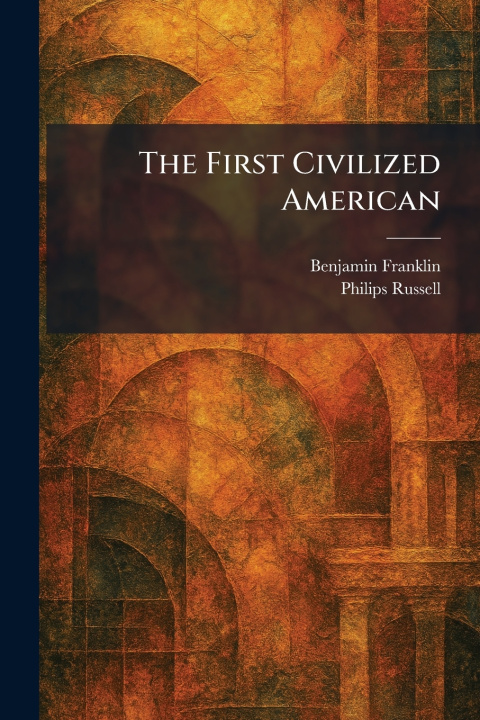
'The First Civilized American' is an insightful and compelling biography of Benjamin Franklin, one of the most versatile figures in world history. Written by Philips Russell, this work explores the life and legacy of a man who was not only a statesman and diplomat but also a scientist, inventor, and philosopher. Often regarded as the quintessential American, Franklin is presented here as a bridge between the traditions of Europe and the emerging cultural identity of the United States.
The narrative delves into Franklin's wide-ranging achievements, from his pioneering experiments with electricity to his critical role in the American Revolution and the drafting of the nation's founding documents. Russell examines Franklin's character in depth, highlighting his wit, pragmatism, and the profound intellectual influence he exerted on both sides of the Atlantic. By focusing on his social interactions and his evolution as a public figure, the book paints a vivid portrait of a man whose curiosity helped shape a new nation. This biography remains a significant resource for those interested in the Enlightenment, the foundations of American democracy, and the life of a true polymath who redefined the 18th-century world.
This work has been selected by scholars as being culturally important, and is part of the knowledge base of civilization as we know it. This work was reproduced from the original artifact, and remains as true to the original work as possible. Therefore, you may see the original copyright references, library stamps (as most of these works have been housed in our most important libraries around the world), and other notations in the work.
This work is in the public domain in the United States of America, and possibly other nations. Within the United States, you may freely copy and distribute this work, as no entity (individual or corporate) has a copyright on the body of the work.
As a reproduction of a historical artifact, this work may contain missing or blurred pages, poor pictures, errant marks, etc. Scholars believe, and we concur, that this work is important enough to be preserved, reproduced, and made generally available to the public. We appreciate your support of the preservation process, and thank you for being an important part of keeping this knowledge alive and relevant.