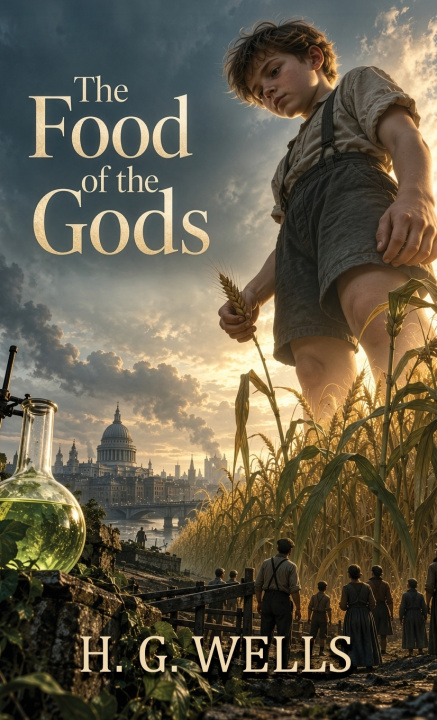
Two scientists discover a substance that makes living things grow far beyond their natural size. What begins as an experiment in biological possibility quickly escapes controlled conditions, producing enormous plants, animals, and eventually human beings.
Mr. Bensington and Professor Redwood call the substance Herakleophorbia, but it soon becomes known more dramatically as the Food of the Gods. Its effects are spectacular and uncontrollable. Chickens, rats, insects, plants, and children grow to extraordinary proportions, forcing ordinary society to confront creatures and people who no longer fit the physical or social scale for which the existing world was built.
Wells treats the premise as both adventure and social satire. Giant animals create immediate danger, but the deeper conflict emerges when giant children become a new generation with needs, ambitions, and physical power that conventional institutions cannot comfortably contain. Their existence transforms a scientific experiment into a struggle between defenders of the established order and beings who literally and symbolically exceed it.
The novel repeatedly asks whether society can make room for transformative change or will instead try to suppress whatever threatens familiar boundaries. Scientific experimentation, public fear, bureaucracy, property, family life, and political authority all become part of the conflict as the consequences of the Food spread beyond anything its creators imagined.
Published in 1904 as The Food of the Gods and How It Came to Earth, the novel combines speculative science, adventure, satire, and social criticism. For readers of classic science fiction, biological speculation, giant-creature stories, and novels about societies confronting disruptive change, it offers a strange and provocative vision of growth as both scientific marvel and social crisis.