copy
Search Terms
global politics, wars, superpower, international relations
copy
Ebook Description
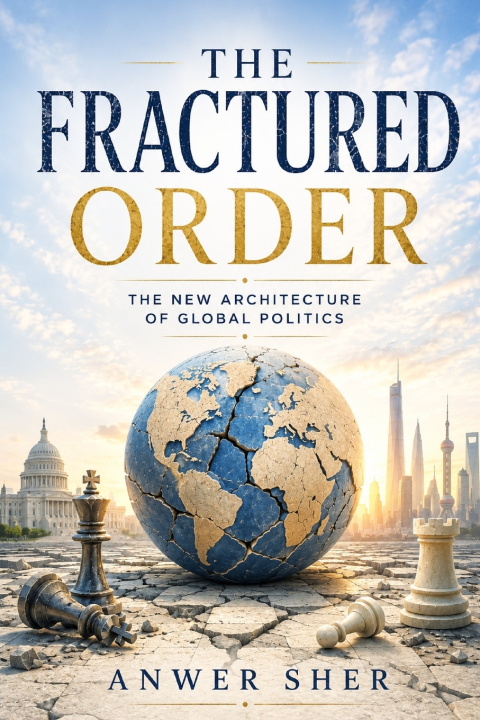
"We are no longer living in a world defined by a clash of civilizations, but rather by a clash of architectures-where competing systems of technology, finance, and security vie to dictate the terms of human survival."
Central to the thesis of The Fractured Order is the rapid acceleration of what I term "hybrid polarity." No longer can we simplify global tensions into a neat binary struggle between East and West, or democracy and autocracy. The reality moving toward 2030 is far more complex. It is a world where a nation can be a vital trade partner to one bloc, a defense ally to a second, and a fierce technological competitor to both. The traditional civil-military balances that once guaranteed domestic stability within key pivotal states-a theme I explored extensively in The Sword and the Scales-are being radically rewritten by digitized surveillance, cyber warfare, and algorithms that bypass conventional institutional checks and balances.
This institutional decay is occurring simultaneously with a massive geographic displacement of economic momentum. The global centers of gravity are drifting inexorably away from historical Atlantic strongholds toward shifting axes in Eurasia and the Global South. Operating within the vibrant, rapidly evolving nexus of the United Arab Emirates has provided me with a unique vantage point to witness this transformation firsthand. The Middle East, long treated as a mere theater for external superpower competition, has refashioned itself into a sophisticated crossroads of active multi-alignment, balancing relationships with Western capital, Eastern technology, and localized resource networks. This regional repositioning is not an anomaly; it is a blueprint for survival in the coming decade.
Yet, this book is not merely an academic text on macroeconomics or international relations. To capture the human element of a world coming apart at the seams, an author must look beyond policy whitepapers and statistical balance sheets. Throughout my creative life-whether through the lens of photography, the rhythm of poetry in Tumbleweed, or the patient, quiet discipline of natural horsemanship detailed in Learning Liberty-I have always believed that structural truths are best understood through observation, patience, and an awareness of natural boundaries. When we push a system past its natural equilibrium, it breaks. This holds true whether one is attempting to build a seamless partnership with a horse, or attempting to maintain an artificial political equilibrium over a deeply divided populace.