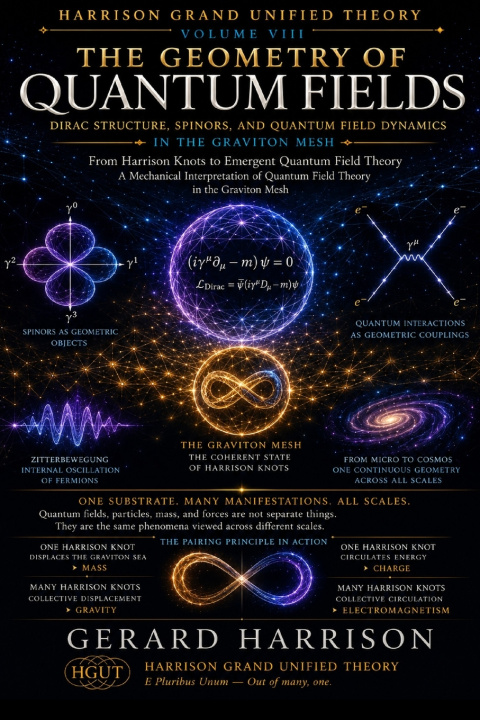
Harrison Grand Unified Theory - Volume VIII
The Geometry of Quantum Fields
What if quantum fields are not fundamental, but emergent?
Volume VIII of the Harrison Grand Unified Theory develops a new geometric interpretation of quantum field theory in which fields, particles, and interactions arise from the collective dynamics of Harrison Knots organized within the Graviton Mesh.
Rather than treating quantum fields as the primitive ingredients of nature, this volume investigates whether they are large-scale manifestations of a deeper physical constituent. Stable particles become topological structures, quantum fields become coherent collective excitations, and many of the most puzzling features of modern physics emerge from the organization of a single underlying system.
Building upon the foundations established in the earlier HGUT volumes, this work reinterprets familiar concepts-including the Higgs mechanism, Zitterbewegung, vacuum fluctuations, and quantum field propagation-within a unified mechanical framework. The volume also explores the relationship between microscopic oscillations, zero-point energy, cosmological evolution, and the large-scale structure of the universe through the Super Ball Principle.
Among the central ideas introduced is the Pairing Principle, a unifying perspective relating particle-scale and collective phenomena. Within this framework, mass and gravity emerge as different scales of the same underlying displacement process, while charge and electromagnetism arise as different scales of the same circulation process.
Rather than presenting quantum field theory as a collection of independent axioms, The Geometry of Quantum Fields seeks to reconstruct it from a single physical ontology based on Harrison Knots and their collective organization.
Whether ultimately confirmed or challenged, this volume offers a systematic attempt to bridge particle physics, quantum field theory, gravitation, and cosmology within one continuous geometric framework.
Volume VIII extends the HGUT program from quantum mechanics to quantum fields, arguing that the familiar machinery of modern physics may be the emergent geometry of a deeper and more fundamental reality.