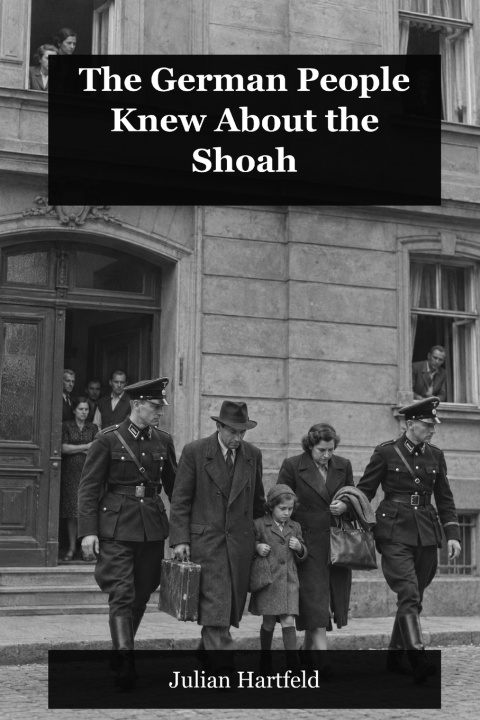
How much did ordinary Germans know about the Holocaust while it was happening?
The familiar postwar answer was simple: the Final Solution had been a closely guarded secret, known only to a narrow circle of Nazi leaders and direct perpetrators. Yet Jewish persecution unfolded in public across Nazi Germany. Neighbors watched families disappear from apartment buildings. Buyers acquired Jewish businesses, furniture, and household goods. Civil servants prepared deportation lists and confiscation files. Police escorted children, elderly people, and the sick to collection centers. Railway workers moved guarded transports east, while the deported stopped writing and did not come home.
The German People Knew About the Shoah examines this history without confusing knowledge of the outcome with knowledge of every killing method. A civilian did not need to see an Auschwitz gas chamber to understand that deportation under a regime publicly threatening Jewish annihilation was not harmless resettlement. The evidence came in fragments: the yellow badge, Kristallnacht, empty homes, one-way trains, soldiers' stories from the Eastern Front, photographs of shootings, BBC broadcasts, Allied leaflets, rumors of mass murder, and the visible prisoners of concentration-camp subcamps.
Julian Hartfeld follows those fragments through the institutions and social networks of the Third Reich. The investigation reconstructs the role of local authorities, tax offices, landlords, businesses, the Reichsbahn, police forces, military personnel, churches, and families. It also examines Action T4, the murder of disabled patients inside Germany, where buses, crematoria, false death certificates, and public sermons showed how a supposedly secret killing program could become common knowledge without appearing openly in the controlled press.
Contemporary diaries, letters, Security Service reports, court files, deportation records, and resistance texts reveal different levels of awareness. Some witnesses knew specific killing sites or mass shootings. Others heard secondhand accounts, recognized that deportees were not expected to return, or inferred the result from repeated disappearance and the regime's own language. The book preserves those differences instead of claiming that every German possessed identical information.
It then turns to the liberation of Buchenwald, Ohrdruf, Dachau, and other camps, the forced visits imposed on nearby civilians, and the rapid spread of the claim that no one had known anything. Wartime documents allow that claim to be tested against what named individuals, offices, communities, and military units had already encountered before 1945.
For readers of Holocaust history, Nazi Germany, Third Reich history, and studies of ordinary Germans under dictatorship, this book offers a factual account of public persecution, Jewish deportations, wartime knowledge, the Final Solution, collective memory, and the difficult boundary between uncertainty, disbelief, silence, and denial.