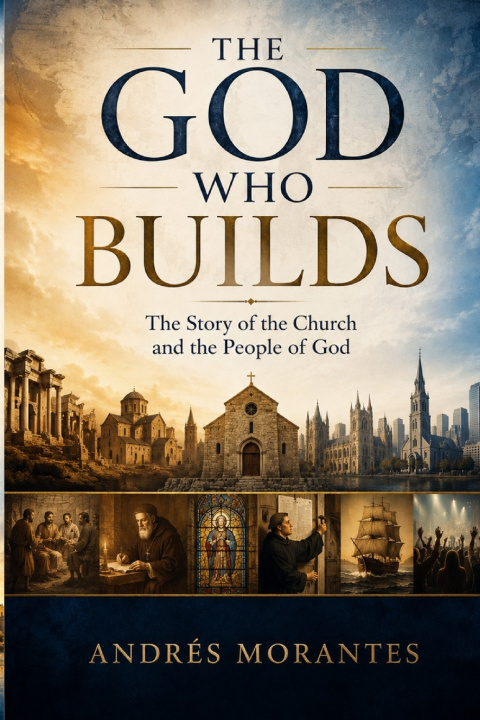
Every book in this series has begun with a conviction about what its subject actually is, because the word in question has too often been worn thin by careless use. This book begins with a parallel conviction about Church history itself: that it is not merely a record of what human beings have done in Christ's name, but an ongoing account of what Christ himself has been doing with, through, and at times despite the people who have carried his name across twenty centuries.
The chapters that follow are organized into seven parts, each named for a facet of God's own building work: the God who begins, who preserves, who leads through history, who reforms, who sends his people, who restores, and who is still building. This structure is not a rhetorical device layered over a conventional chronological survey; it is the actual argument of the book. Each part asks not only what happened in a given period of Christian history, but what the promise of Matthew 16:18 looked like being kept within it.
This book does not pretend the Church's history is a story of uninterrupted faithfulness. Chapter 25, "When the Church Failed," confronts directly some of the gravest failures committed in Christ's name - the Crusades, the Inquisitions, complicity in slavery and colonial abuse, silence and complicity under Nazism, and the modern crisis of institutional abuse - because a history that omits these chapters is not history at all, and because, as that chapter itself argues, God's faithfulness becomes more visible, not less, when honestly measured against human failure rather than protected from the comparison.
Scripture quotations throughout are taken from the New International Version. Key moments in the story are anchored, as in this series' companion volumes, to both Old and New Testament texts, tracing the conviction that the Church's history did not begin at Pentecost but was already underway in God's calling of Abraham, his covenant with Israel, and his prophets' long anticipation of a people gathered from every nation.
I do not write as a neutral chronicler. I write as a pastor and a son of the Church who has watched her fail and has also watched her rise, generation after generation, in places and among peoples no one predicted. My hope for this book is the same hope carried by every volume in this series: that in tracing what God has done, the reader would come to trust more deeply what God is still doing - in the Church of this present century, and in whatever small corner of it each reader has been given to serve.
- Andrés Morantes