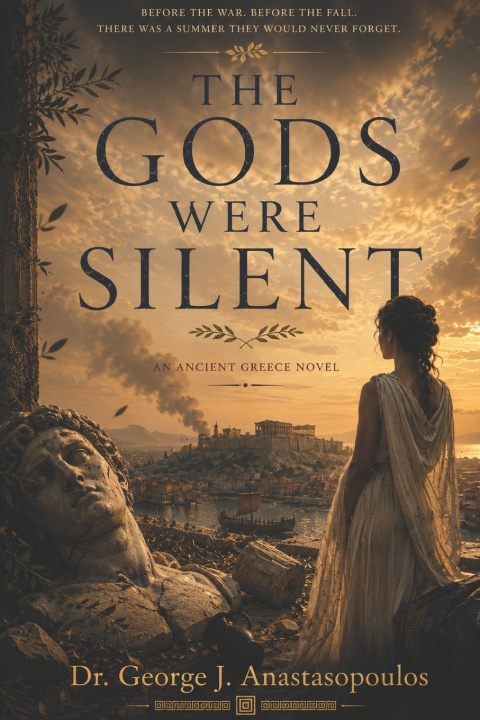
In the golden age of Athens, beneath the olive groves and sea winds of Aixone, three young lives grow together within the household of the aristocrat Kallias: His son Leandros, his daughter Elpinike and Lykon, a slave boy whose family was destroyed by debt and misfortune.
What begins as childhood companionship slowly deepens into forbidden love as Athens itself moves toward war and decline. While philosophers speak of virtue and democracy, the realities of class, duty and fate shape the lives of those beneath the city's greatness.
From sacred festivals and hidden springs to crowded wartime Athens and brutal hoplite battlefields, this richly atmospheric historical novel brings Classical Greece vividly to life through a story of love, loss, friendship and the painful cost of freedom.
The events of this novel take place during the Golden Age of Athens in the fifth century BCE, a period often regarded as one of the most remarkable eras in ancient Greek history. Under the leadership of Pericles, Athens stood at the height of its political influence, economic prosperity, artistic achievement, and intellectual innovation. The Parthenon had recently risen upon the Acropolis, philosophers debated in public spaces, playwrights filled the theaters with new dramas, and merchants connected the city to distant shores across the Mediterranean.
Yet beneath this brilliance lay tensions that would ultimately reshape the Greek world. Athens presided over a vast maritime alliance that brought wealth and power but also provoked fear and resentment among rival city-states, particularly Sparta. Social divisions remained deeply embedded within Athenian society. Citizens, foreigners, women, and slaves lived under very different expectations and limitations, despite sharing the same streets, sanctuaries, and festivals.
The story unfolds primarily in the deme of Aixone, a coastal community south of Athens whose vineyards, olive groves, fishing boats, and rural estates stood in contrast to the crowded urban life of the city itself.