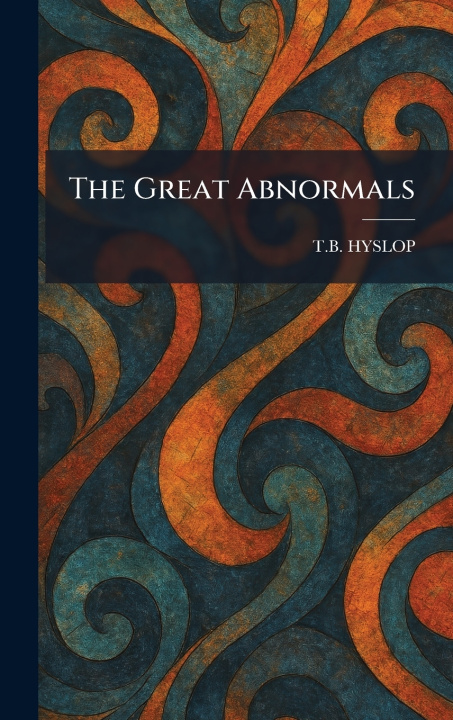
"The Great Abnormals" is a fascinating psychological and historical exploration into the lives of notable figures throughout history whose behaviors and temperaments deviated from the norm. Written by the esteemed psychiatrist T.B. Hyslop, the work examines the intersection of genius, eccentricity, and mental instability. By analyzing the lives of kings, artists, leaders, and thinkers, Hyslop investigates how abnormal psychological traits have influenced human achievement and historical events.
The book serves as a scholarly yet accessible study of the human mind, challenging the reader to consider the thin line between madness and greatness. Hyslop employs his clinical expertise to provide insights into the temperaments of historical icons, offering a unique perspective on how psychological idiosyncrasies have shaped the course of civilization. "The Great Abnormals" remains a compelling read for those interested in the history of psychiatry, the nature of brilliance, and the complex mysteries of human personality. Through its detailed vignettes, the work illuminates the peculiar characteristics that often accompany extraordinary individuals, making it an essential text for understanding the psychological dimensions of history.
This work has been selected by scholars as being culturally important, and is part of the knowledge base of civilization as we know it. This work was reproduced from the original artifact, and remains as true to the original work as possible. Therefore, you may see the original copyright references, library stamps (as most of these works have been housed in our most important libraries around the world), and other notations in the work.
This work is in the public domain in the United States of America, and possibly other nations. Within the United States, you may freely copy and distribute this work, as no entity (individual or corporate) has a copyright on the body of the work.
As a reproduction of a historical artifact, this work may contain missing or blurred pages, poor pictures, errant marks, etc. Scholars believe, and we concur, that this work is important enough to be preserved, reproduced, and made generally available to the public. We appreciate your support of the preservation process, and thank you for being an important part of keeping this knowledge alive and relevant.