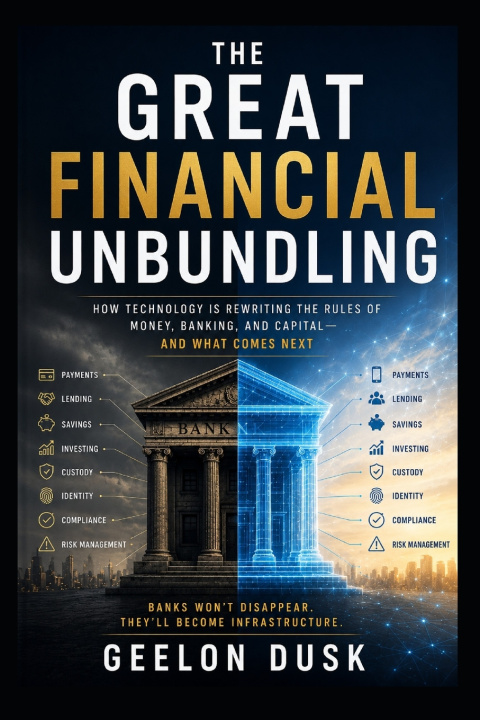
For centuries, banks have stood at the center of the global economy. They safeguard our savings, finance our homes, facilitate our payments, and help governments manage monetary policy. We have come to see them as permanent institutions.
But what if they aren't?
In The Great Financial Unbundling, entrepreneur and researcher argues that banking is not a single business-it is a bundle of services that evolved when technology made centralization the most efficient solution.
Today, that assumption is changing.
Artificial intelligence is transforming credit analysis. Digital identity is reshaping trust. Real-time payments are making money move instantly. Marketplace lending, tokenization, embedded finance, and global digital platforms are beginning to separate payments, lending, investing, custody, and identity into specialized ecosystems.
The result is not the end of banking.
It is the unbundling of banking.
Drawing on history, economics, technology, and finance, this book traces the evolution of money from goldsmiths to central banks, explains how modern financial systems really work, examines why access to capital differs across society, and presents a bold but carefully argued vision of how finance may evolve over the coming decade.
Whether you are an investor, entrepreneur, policymaker, banker, or simply someone who wants to understand where money is going next, The Great Financial Unbundling offers a new framework for thinking about one of the world's oldest industries.
The future of finance won't be built by replacing banks.
It will be built by reimagining what banks are.
Elevator Pitch (30 Seconds)
Banks were created because they solved a coordination problem: connecting savers with borrowers in a world where information moved slowly and trust was expensive.
Today, artificial intelligence, digital identity, real-time payments, and open financial networks are dramatically reducing the cost of coordination.
This book argues that banking is entering the same transformation that reshaped media, retail, travel, and communications-not because banks are failing, but because technology allows their individual services to exist independently.
The future isn't banking without banks.
It's banking after banks.