A federal judge in a single courthouse halts a national policy overnight, before any full hearing on its merits. An executive agency rewrites the national energy economy on the basis of four words in a statute. An administration defies court orders, impounds congressional appropriations, and instructs officials not to testify before Congress. And Congress watches - holding hearings, issuing statements, doing almost nothing.
These patterns have developed across Republican and Democratic administrations, through Congresses controlled by both parties, under judges appointed by presidents of every orientation. They are not the failures of particular actors. They are the failures of a structure.
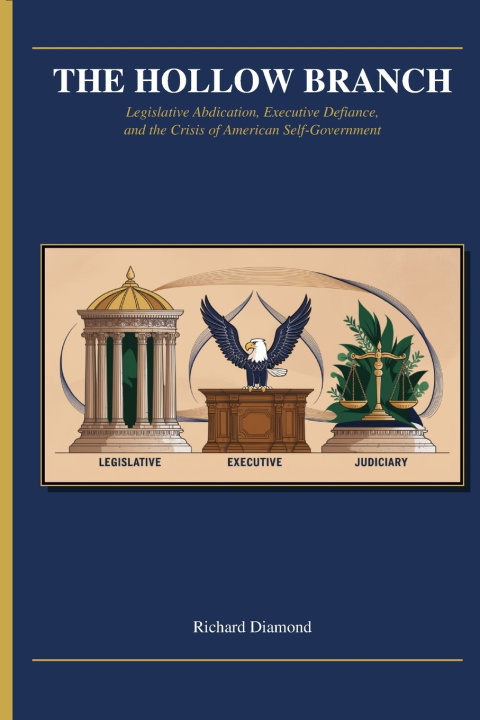
The Hollow Branch makes a specific constitutional argument: Congress - the branch the Constitution places first, and vests with all legislative power - has engaged in systematic deliberate abdication. Not laziness. Not incapacity. A calculated institutional choice to pass laws that announce goals without making the hard choices those goals require, delegating authority without specifying its limits, and leaving to agencies, courts, and the executive the politically costly work of deciding what the law actually means. The strategy has a name: accountability arbitrage. Congress captures the credit of legislation while transferring its costs to institutions the governed cannot vote out of office.
The consequences have accumulated for ninety years. Administrative agencies issue hundreds of thousands of pages of binding rules annually - rules made by unelected officials interpreting mandates no legislature ever specifically authorized. Courts govern prisons, school systems, and police departments through decades of structural reform litigation - because legislatures declined to specify what the constitutional requirements they nominally honored actually demanded. The Authorization for Use of Military Force, enacted in sixty words in 2001, has authorized military operations in at least eight countries against groups that did not exist when it passed. And when courts order the executive to stop, an administration increasingly treats those orders as advisory.
Richard Diamond traces this failure from Madison's founding design through its long unraveling - the collapse of the nondelegation doctrine after 1935, the forty-year Chevron deference rule that rewarded statutory vagueness with executive authority, the rise of the nationwide injunction, the judicialization of American politics, and an executive defiance problem that represents the most serious challenge to constitutional order since Reconstruction. The diagnosis spans criminal law, civil rights, environmental regulation, and national security, revealing the same constitutional failure operating through different mechanisms across every domain of American governance.
Then, unusually for a book of constitutional diagnosis, The Hollow Branch turns to remedy - specific, grounded, and honestly assessed. What the courts can do, and where doctrine reaches its limits. What Congress must do to discharge the constitutional obligation Article I assigns it. The enforcement mechanisms that make those obligations real. And six constitutional amendments - on emergency powers, impoundment, judicial tenure, nondelegation, presidential disability, and legislative specificity - that address the structural failures no statute can fix.
This is a book for the engaged citizen who has watched the governing judge, the legislating agency, the defiant executive, and the emergency that never ended - and wants to understand not just what went wrong but what the Constitution actually requires, and whether it is still possible to restore it.
The answer is yes. But the argument needed to be made plainly. This book makes it.