Why can a person understand the consequences of substance use, sincerely want to stop, and still feel driven toward immediate relief?
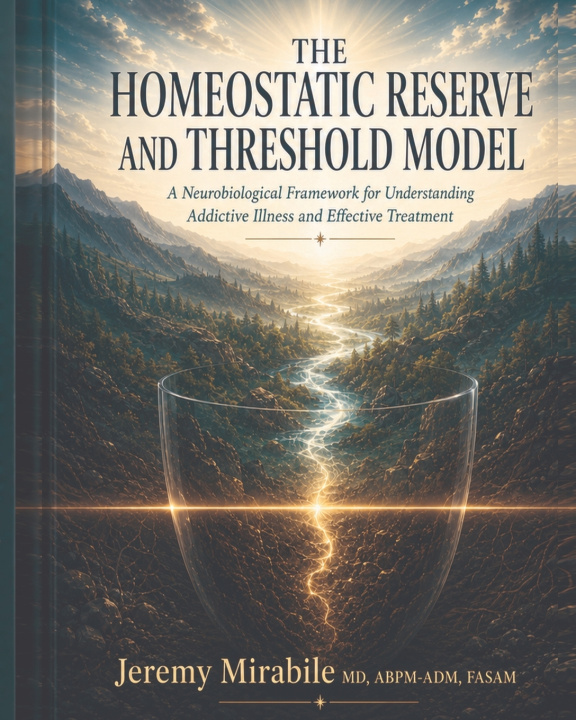
Drawing on addiction neuroscience, clinical experience, and recovery science, physician and addiction medicine specialist Jeremy Mirabile, MD, ABPM-ADM, FASAM, introduces the Homeostatic Reserve and Threshold Model-a practical conceptual framework for understanding how addictive illness can alter a person's capacity to regulate behavior, tolerate distress, respond to natural rewards, and act consistently with long-term values.
The model is organized around three central concepts: homeostatic reserve, the homeostatic threshold, and the healing trajectory. It explains how genetic vulnerability, trauma, chronic stress, psychiatric illness, repeated substance exposure, and environmental pressures may progressively weaken the functional capacity available for healthy decision-making. It also illustrates how abstinence, effective treatment, appropriate medication, structure, supportive relationships, recovery capital, and value-congruent living can help restore that capacity over time.
The Homeostatic Reserve and Threshold Model is not presented as a biomarker, a measurable neurological cutoff, or a replacement for established diagnostic and treatment-placement standards. Instead, it provides clinicians, patients, families, educators, and recovery communities with a shared language for understanding impaired choice, relapse vulnerability, treatment timing, accountability, and the gradual restoration of self-regulation.
By connecting scientific evidence with lived clinical experience, this book offers a compassionate but responsible account of addiction as a medical illness rather than a moral identity. It explains why the fight against addiction can become profoundly unequal during active illness-and how treatment can make that fight more fair.
Recovery involves more than stopping substance use. It includes rebuilding the capacity for responsibility, relationships, purpose, emotional regulation, and meaningful living. This book provides a clinically useful and hopeful framework for understanding how that restoration can occur.