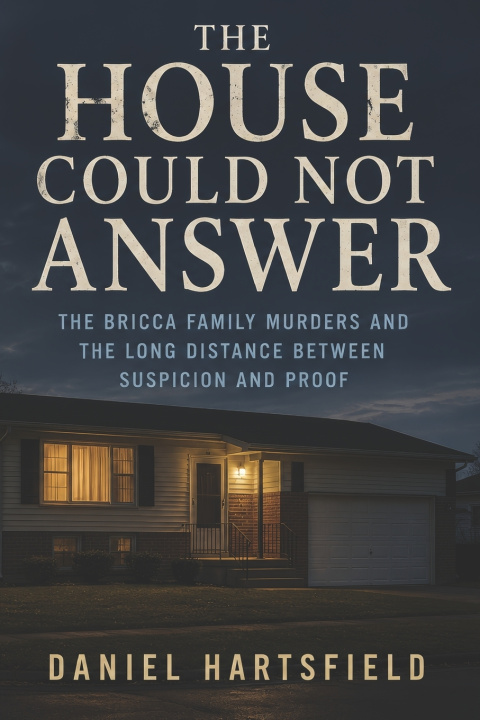
Three lives. One house. A cold case still suspended between suspicion and proof.
In September 1966, Gerald, Linda, and four-year-old Debbie Bricca were found dead in their Greenway Avenue home in Hamilton County, Ohio. No person has been publicly charged or convicted. The House Could Not Answer is a victim-centered historical true crime account of the Bricca family murders-an unresolved Cincinnati-area homicide case that has endured through decades of investigation, forensic hope, public theory, and unanswered questions.
The narrative begins before the house became a crime scene. Gerald is restored as a young chemical engineer, Linda as a former flight attendant and mother whose life was later narrowed by rumor, and Debbie as a four-year-old child with a place in the daily world of family, pets, sidewalks, and neighbors. Their lives come first, before the case file and before the theories that followed.
From there, the book reconstructs the final known routines surrounding the family's disappearance from public view: Sunday obligations, unanswered calls, a missed work commitment, newspapers left outside, trash cans not returned, lights that did not change, dogs whose routine had stopped, and the neighbors who finally approached the door. These ordinary details form the edge of a timeline without pretending to reveal what the record cannot establish.
Inside the investigation, the book examines the rooms, the reported bindings and tape, the missing weapon and materials, the physical evidence collected before modern DNA profiling, and the early circle of leads. It follows how fingerprints, hairs, biological material, witness statements, and changing forensic methods carried both possibility and limitation across decades. Later testing and genetic-genealogy efforts are treated as continued investigation-not as closure where no public charge or courtroom finding followed.
The account also confronts the distance between an investigated lead and a legally proven conclusion. It considers how one uncharged person of interest came to dominate public memory, how repeated suspicion can harden into apparent certainty, and how unresolved true crime can reshape the reputations of victims and others when no verdict exists to define the record.
Built from available official cold-case material, public statements, credible reporting, retrospective interviews, and documented secondary research, the book distinguishes confirmed fact from reported information, allegation, interpretation, and speculation. It does not invent dialogue, private thoughts, motives, or final moments. Sensitive evidence, child-victim material, injury descriptions, and untested accusations are handled with deliberate restraint.
With a detailed timeline, key-people glossary, and source index, The House Could Not Answer offers an evidence-aware reading experience for those drawn to cold case books, historical true crime, forensic investigation, unsolved Ohio murders, and the difficult boundary between what people believe and what the law can prove.
Open the record and follow the case through what is known, what is disputed, and what remains unanswered.