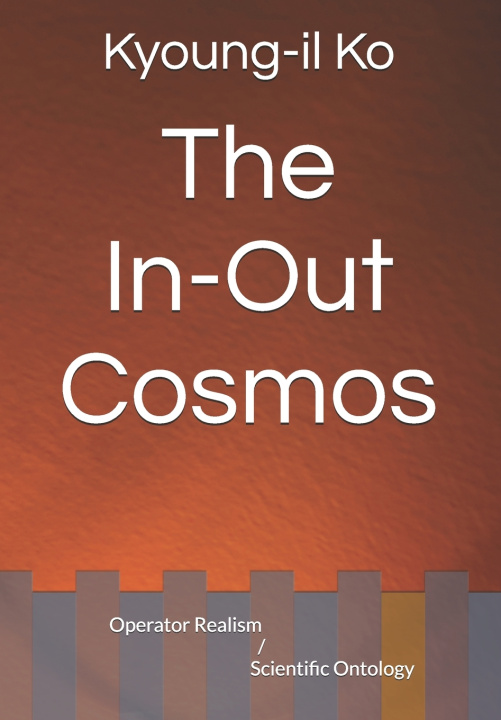
The In-Out Cosmos: Operator Realism and Scientific Ontology
What is the most fundamental structure of reality? Are objects, processes, relations, information, or consciousness the primary constituents of the world? The In-Out Cosmos advances a new answer to this question through the framework of In-Out Ontology (IOO) and the development of Operator Realism as a scientific ontology.
At the foundation of the theory are In-Out Indistincts (IOIs)-ontological primitives that are neither inward nor outward in themselves. Through In-Out Entanglement (IOE), these primordial entities generate the directional distinctions from which structure, matter, life, cognition, society, and consciousness emerge. Rather than treating the world as a collection of static objects or abstract relations, Operator Realism proposes that reality is constituted by operators that continuously participate in the formation and transformation of layered relational structures.
Drawing upon insights from philosophy of science, quantum theory, complexity science, systems thinking, cognitive science, and social theory, the book develops a unified ontological framework capable of addressing questions that traditionally belong to separate disciplines. The same underlying principles are used to explore physical reality, biological organization, conscious experience, social cooperation, institutional dynamics, and cultural evolution.
Central to the framework is the claim that reality is neither fundamentally individualistic nor fundamentally holistic. Instead, it is generated through the ongoing interplay of inward and outward directionalities. Cooperation and competition, integration and differentiation, subjectivity and objectivity, order and novelty are interpreted as manifestations of deeper in-out dynamics operating across multiple scales of existence.
The book introduces original concepts including In-Out Entanglement, Operator Realism, the LPTR (Layer, Plurality, Transition, Ratio) architecture of consciousness, participatory fields, layered reality, cognitive-participatory spaces, and developmental trajectories of conscious participation. These concepts are integrated into a systematic scientific ontology that seeks to bridge long-standing divides between matter and mind, individual and society, science and philosophy.
Rather than offering another specialized theory within a single discipline, The In-Out Cosmos presents an ambitious attempt to articulate a general ontology for an interconnected universe. It proposes that the emergence of structure, meaning, life, and consciousness can be understood as successive expressions of a deeper participatory architecture grounded in the dynamics of in-out relations.
For readers interested in metaphysics, philosophy of science, consciousness studies, complexity theory, systems thinking, social theory, and the future foundations of scientific ontology, this book offers a comprehensive exploration of reality through the lens of In-Out Ontology and Operator Realism.