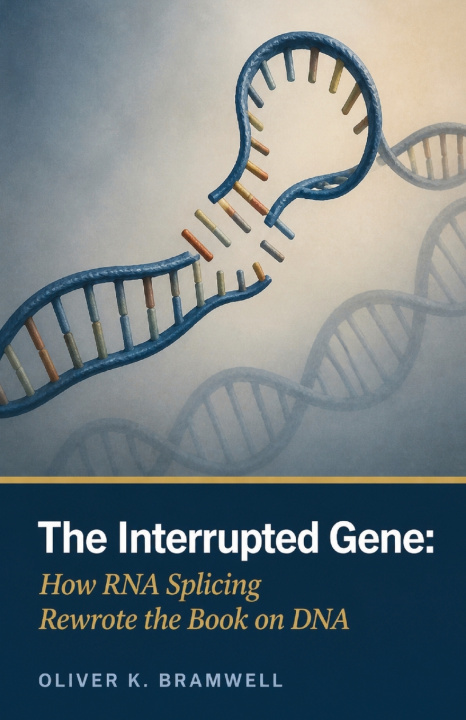
For decades, biologists pictured a gene as an unbroken line of code, a recipe read from start to finish. Then, in 1977, a humble cold virus revealed that genes are riddled with interruptions, long stretches of sequence that never become protein. Why would life carry such gaps, and how does a cell edit them out flawlessly? This book is for curious readers who love a great scientific mystery, no biology degree required.
You will follow the detective story behind the discovery, from looping molecules glimpsed under an electron microscope to the Nobel Prize-winning work of Richard Roberts and Phillip Sharp. You will meet the spliceosome, a molecular machine that cuts and joins RNA with single-letter precision, and discover RNA that edits itself. Along the way, you will see how one gene can build many proteins, and what happens when the edit goes wrong.
Concise, vivid, and rich in human stories, this Very Short Introduction-style guide turns a once-baffling finding into a clear, satisfying narrative. It explains how the humble gaps in our DNA help explain evolution, human complexity, and modern medicine, and it ends by looking ahead at therapies that edit the editor itself.