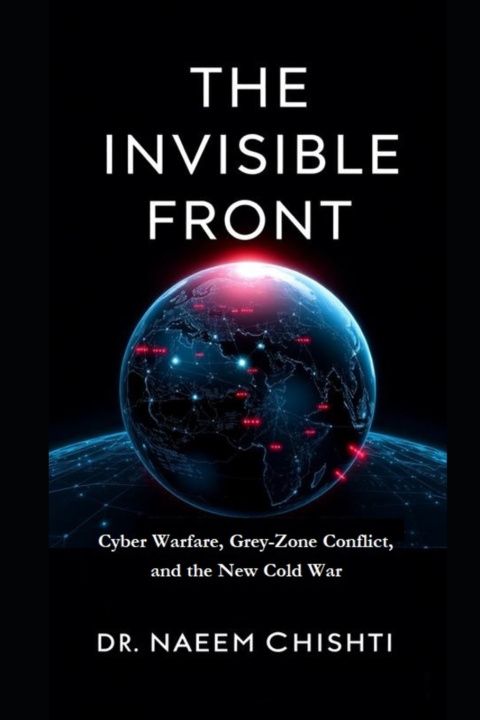
The next great conflict is already underway. It is fought not only with missiles and tanks, but with malware, algorithms, disinformation, economic coercion, and the silent manipulation of the digital systems that underpin modern life.
In The Invisible Front, cyber warfare is examined not as a technical phenomenon, but as a defining feature of twenty-first-century geopolitics. As strategic competition intensifies among the world's major powers, cyberspace has become a permanent arena of conflict-one in which states, intelligence agencies, criminal organisations, private companies, and non-state actors compete continuously below the threshold of conventional war.
This book argues that we have entered a new era of persistent grey-zone competition, where the traditional distinction between peace and war is steadily eroding. From attacks on critical infrastructure and industrial espionage to information operations, artificial intelligence, and the weaponisation of global technology supply chains, digital power has become central to national security, economic resilience, and international influence.
Drawing on contemporary conflicts and real-world case studies-including Ukraine, the Middle East, the Indo-Pacific, and South Asia-the book explores how cyber operations are integrated with military strategy, diplomacy, economic statecraft, and intelligence. It examines the strategic importance of subsea cables, satellites, cloud infrastructure, semiconductors, and software ecosystems, revealing how the invisible architecture of the digital age has become a primary battleground in global competition.
The Invisible Front also looks beyond today's threats to the challenges that will shape tomorrow's security environment. Artificial intelligence, cognitive warfare, deepfakes, autonomous systems, digital sovereignty, and the fragmentation of the global internet are transforming not only how wars are fought, but how societies are influenced, governments are challenged, and power itself is exercised.
Rather than focusing solely on technology, this book places cyber warfare within its broader political, economic, and strategic context. It explains why cyber conflict is no longer an isolated domain reserved for technical specialists, but a fundamental element of international relations that affects governments, businesses, institutions, and citizens alike.
Rigorous yet accessible, The Invisible Front offers a comprehensive analysis of one of the most significant transformations in modern security. It demonstrates that the future of conflict will not be defined solely by the control of territory, but by the control of information, technology, infrastructure, and trust.
For policymakers, military professionals, intelligence practitioners, business leaders, scholars, students, and anyone seeking to understand the changing nature of global power, The Invisible Front provides an essential guide to the unseen battles that are reshaping the international order.
The invisible front is not a distant battlefield. It is the connected world we inhabit every day.