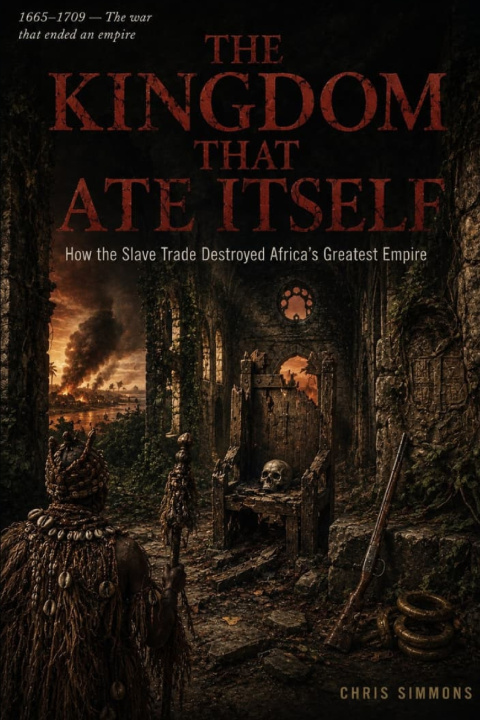
How the Slave Trade Destroyed One of Africa's Greatest Kingdoms
For centuries, the Kingdom of Kongo stood among the most powerful and sophisticated states in Africa. Stretching across vast territories in Central Africa, it maintained diplomatic relations with European powers, embraced Christianity, developed complex political institutions, and fostered a thriving culture that connected millions of people. Its rulers corresponded with kings and popes, its capital was one of the largest cities in sub-Saharan Africa, and its influence extended far beyond its borders.
Yet despite its strength and prestige, the kingdom would eventually collapse.
In The Kingdom That Ate Itself, historian Chris Simmons explores the dramatic rise and tragic fall of the Kingdom of Kongo. Beginning with its emergence as a regional power and its early encounters with the Portuguese, the book traces how trade, diplomacy, religion, and political ambition transformed the kingdom's destiny.
At the heart of the story lies the Atlantic slave trade. What began as a commercial relationship gradually evolved into a destructive system that fueled corruption, intensified rivalries among the elite, and weakened the foundations of Kongolese society. As competition for power increased, successive rulers struggled to maintain unity while foreign interests expanded their influence throughout the region.
The narrative follows the reign of King Afonso I, whose efforts to protect his people from illegal enslavement were undermined by powerful interests on both sides of the Atlantic. It examines the growing instability caused by succession disputes, the rise of military factions, and the devastating consequences of the Battle of Mbwila in 1665, where the death of King António I triggered decades of civil war.
Drawing on historical records, missionary accounts, oral traditions, and modern scholarship, this book reveals how internal conflict, political fragmentation, and the slave trade combined to dismantle one of Africa's most remarkable civilizations. It also explores the destruction of São Salvador, the struggles between rival royal houses, and the long legacy of the kingdom's collapse in modern Central Africa.
More than a history of kings and battles, The Kingdom That Ate Itself is a study of how powerful societies can be weakened from within when political division, economic interests, and foreign influence converge. It is the story of a kingdom that once stood among Africa's greatest powers and the forces that ultimately brought it to ruin.
This is the story of the Kingdom of Kongo-its rise, its glory, and its tragic fall.