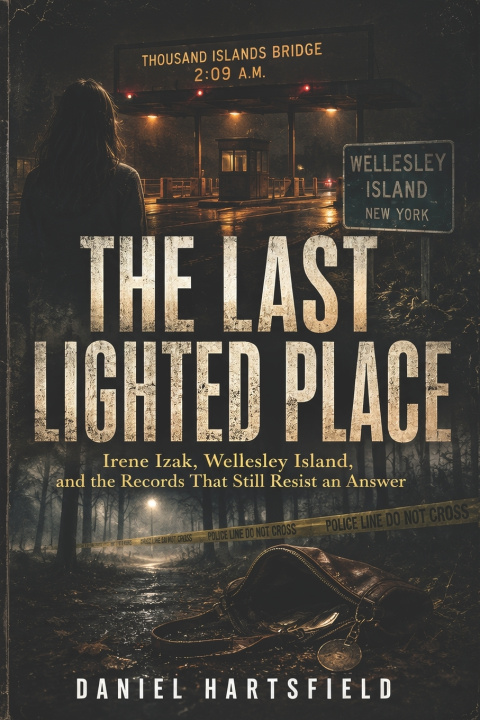
An unresolved homicide. A narrow timeline. A public record that still refuses to close.
This historical true crime investigation follows the unresolved 1968 homicide of Irene Juliana Izak, a twenty-five-year-old former French teacher whose final journey toward Quebec ended near Wellesley Island, New York.
The Last Lighted Place traces Irene's life before the case file: a young woman shaped by migration, education, language, teaching, and purposeful movement. Before the tollbooth, the stopped Volkswagen, the embankment, and the decades of unanswered questions, Irene was driving toward a professional opportunity and a future still open to her.
The book follows the known public sequence with restraint: a reported traffic stop, a sighting at the Thousand Islands Bridge toll area, a car found with its lights still on, and a body discovered nearby. It examines what the record can support, what remains disputed, and why the case became more than a roadside cold case.
At the center is the difficult space between suspicion and proof. Public reporting and records-access material placed Trooper David N. Hennigan within the case record, but no one was ever charged, tried, convicted, or legally adjudicated responsible for Irene's death. This account does not turn suspicion into certainty. It examines why the questions endured.
Moving through family persistence, the 1998 reopening, the reported exhumation, the later fight over records, and the limits of public access, the book explores how an unsolved homicide can become a story about memory, authority, evidence, and institutional opacity.
Written in an evidence-aware narrative nonfiction style, The Last Lighted Place is for readers of true crime cold cases, historical true crime, unsolved murder investigations, and public-records mysteries who want a careful account that honors both the human loss and the legal boundary between allegation and proof.
Step into the road, the record, and the silence that still surrounds Irene Izak's unfinished case.