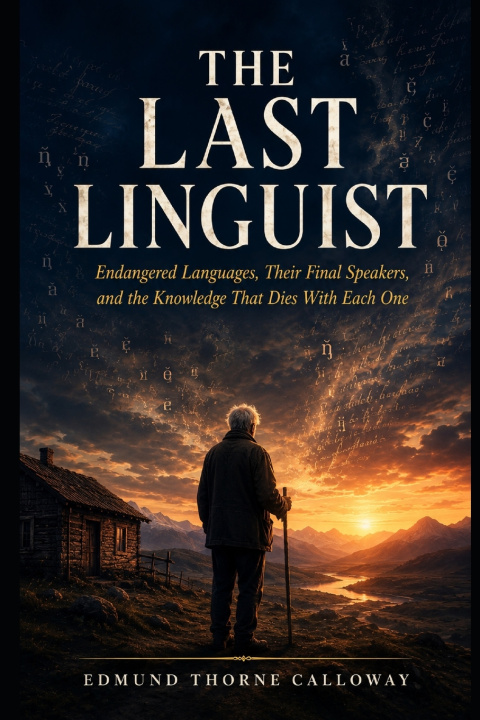
There is a man who wakes up one morning as the only person left on Earth who can speak his own native language. There is a woman who buries a word she has no one left to say it to. There are two elderly neighbors, the last two speakers of their language, living five hundred metres apart, who barely speak to each other at all.
This book is about them, and about the several thousand languages now standing exactly where they once stood.
Somewhere on the planet right now, a language is going silent roughly every two weeks. Not fading, not evolving, but ending, the way a candle ends. When it does, something disappears that no dictionary was ever written to hold: the only known cure for a fever, encoded in a plant name that exists in a single tongue. A grammar that forces its speakers to say, in every sentence, exactly how they know what they claim to know. A memory of where the ice is safe to walk, passed mouth to mouth for ten thousand years.
The Last Linguist follows the true, documented stories of the people standing at that vanishing point. A man in Turkey whose eighty four consonants died with him in a single afternoon. A woman in the Andaman Islands who survived a tsunami because of instructions passed down in a language nobody else alive could still understand. A linguist who discovered, in 2008, an entire previously unknown language spoken by a few hundred people, hiding in plain sight for generations. A mother who dreamed of her ancestors for three nights in a row, then spent a decade teaching herself to speak a language that had not been anyone's mother tongue in a hundred and fifty years, so that her own daughter could become its first native speaker since.
This is not a linguistics textbook, and it is not a eulogy. It reads like the best narrative nonfiction: real people, real stakes, real science, told with the pace and emotional pull of a story you cannot put down. You will meet the scientists proving that losing a language may be a greater threat to medicine than losing the plant itself. You will sit inside the boarding schools where children were beaten for speaking the only words they knew, and understand exactly how a government decided that erasing a language was cheaper than negotiating for land. You will watch Hebrew rise from two thousand years of silence into the mother tongue of millions, and Cornish get reclassified by UNESCO, undoing two centuries of being called extinct.
Every account in this book is real, drawn from verified interviews, peer reviewed research, and the recorded words of the people who lived it. Nothing has been invented to make the story better, because the story does not need help.
By the final page, you will never think about the words in your own mouth the same way again. You will understand why the disappearance of a language is not a footnote to history but one of the great untold losses of our lifetime, and why, in a handful of extraordinary cases, it does not have to be permanent at all.
If you have ever wondered what it would feel like to be the last person who remembers something the whole world once knew, start here.