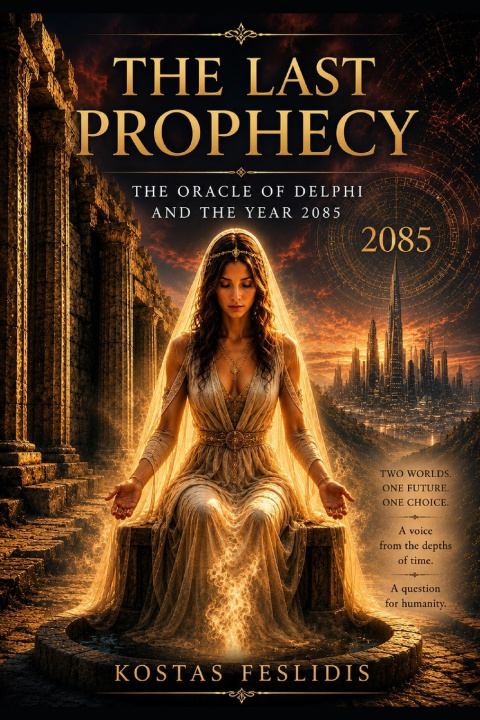
What if the Oracle of Delphi spoke again - not to predict the end of the world, but to ask what kind of future humanity is creating?
In The Last Prophecy - The Oracle of Delphi and the Year 2085, Kostas Feslidis leads readers to one of the most mysterious places of antiquity. Between ancient stones, silence, wind, and memory, Pythia awakens once more. But this time, the oracle does not give simple answers. It opens doors.
The year 2085 becomes a mirror of the choices we make today.
Climate change, artificial intelligence, truth and lies, new wars, migration, consumption, language, children, fear, hope, and human responsibility - all appear before the narrator in powerful visions. Yet this is not a story about a fixed future. It is a literary and philosophical journey about possible paths: a world of convenience and dependence, a world of control and cold rescue, or a world in which humanity still learns to become more human.
As the ancient gods speak through Delphi - Apollo, Athena, Demeter, Hermes, Asclepius, Hades, and Pythia herself - the central question grows clearer with every chapter:
What will become of the human being when the world changes?
This book is not a prophecy of doom. It is a wakeful, poetic, and deeply human reflection on our present and on the future we are already preparing. It asks what remains of truth when language becomes fragile, what happens when machines grow cleverer than our wisdom, what children will ask us one day, and what responsibility means in an age of speed, fear, and endless possibility.
At the heart of the book lies a simple but urgent question:
What should become more human through us?
For readers who enjoy visionary literature, philosophical fiction, modern reflections on antiquity, and books that combine poetic storytelling with the great questions of our time, The Last Prophecy offers a moving journey from Delphi into the future - and back to ourselves.