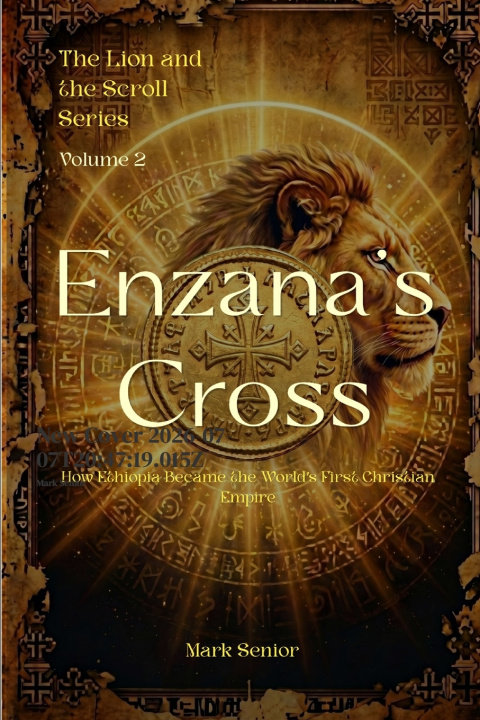
Before Rome. Before Constantinople. Before any European nation wore the cross - one African king put it on his coins.
In 330 AD, give or take a decade, King Ezana of Aksum replaced the pagan sun and crescent on his imperial coinage with a cross. Aksum - ranked by a third-century Persian prophet alongside Rome, Persia, and China as one of the four great powers of the ancient world - had just become, on the evidence of its own currency, the world's first officially Christian empire.
It started with a shipwreck. A boy named Frumentius, taken captive on the Red Sea coast, rose from slave to royal secretary to the tutor of a prince. What he taught that prince changed the religious history of Africa - and arguably the world.
EZANA'S CROSS, Volume Two of The Lion and the Scroll, tells this story through the evidence that still stands: the Ezana Stone's trilingual inscription, the numismatic record of a currency that changed from pagan gods to the cross, the excavated basilica at Beta Samati, and the towering stelae of Aksum itself.
Inside, you'll discover:
- How a slave from Tyre became counsellor to an empire and quietly built the infrastructure for a king's conversion
- The coin evidence placing Aksum's Christian conversion at or before Constantine's own - and why it matters
- Why Ethiopia rejected the Council of Chalcedon, and what that theological independence preserved
- The 81-book Ethiopian biblical canon - including Enoch, Jubilees, and the Meqabeyan - and its confirmation by the Dead Sea Scrolls
- Saint Yared's liturgical music and the unbroken Geʿez tradition still chanted today, fifteen hundred years on
Because Aksum stood outside the Roman Empire, its Christianity developed on its own terms - free of the councils that pruned the Western canon. What survived is, by the evidence, the most complete Bible in the world.
This is the empire the world ranked with Rome and then chose to forget. The Lion and the Scroll brings it back.