AI does not have to feel mysterious. It can become visible, simple, and useful when the reader understands what the machine is actually learning from.
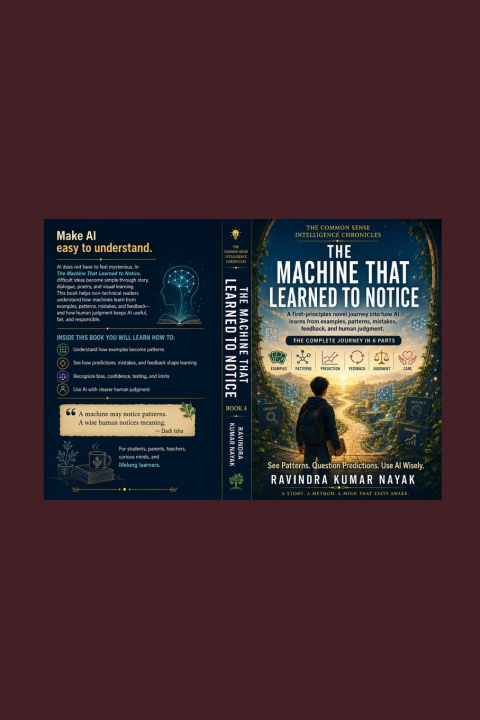
The Machine That Learned to Notice is Book 4 of The Common Sense Intelligence Chronicles, a first-principles storytelling series for non-technical readers, students, parents, teachers, curious adults, and lifelong learners who want difficult ideas to become simple without becoming shallow.
In this warm, visual, dialogue-rich journey, Aarav, Tara, Meera, Niva, Kabir, and Dadi Isha help readers understand Artificial Intelligence from the ground up. The book does not begin with coding, equations, or heavy technical language. It begins with ordinary things: baskets of examples, labels, patterns, mistakes, feedback, confidence, fairness, privacy, and human judgment.
Through story scenes, professional curious dialogues, poetry pauses, visual learning maps, reader workshops, and first-principles explanations, readers learn how machines begin to notice patterns and why human judgment must stay awake.
Inside this book, readers will learn how to:
Understand how AI learns from examples
See how labels, features, and patterns shape machine learning
Recognize why mistakes and feedback help systems improve
Understand bias, testing, confidence, fairness, privacy, and monitoring in simple language
Use AI more wisely without blindly trusting fluent answers
Explain AI to a beginner without fear, jargon, or confusion
Keep human care, responsibility, and judgment at the center of technology
This is not a coding manual. It is a clarity manual. It helps the reader see what is happening beneath the word AI: examples enter, patterns are learned, predictions are made, errors are measured, feedback repairs the path, and human judgment decides what should be trusted.
The Machine That Learned to Notice is for anyone who has ever asked:
How does AI actually learn?
Why can AI sound confident and still be wrong?
What are examples, patterns, predictions, and feedback?
How can ordinary people use AI wisely?
How do we keep technology useful, fair, and responsible?
In a world full of fast answers, this book teaches a calmer skill: see the pattern, question the prediction, check the output, and keep the human mind awake.