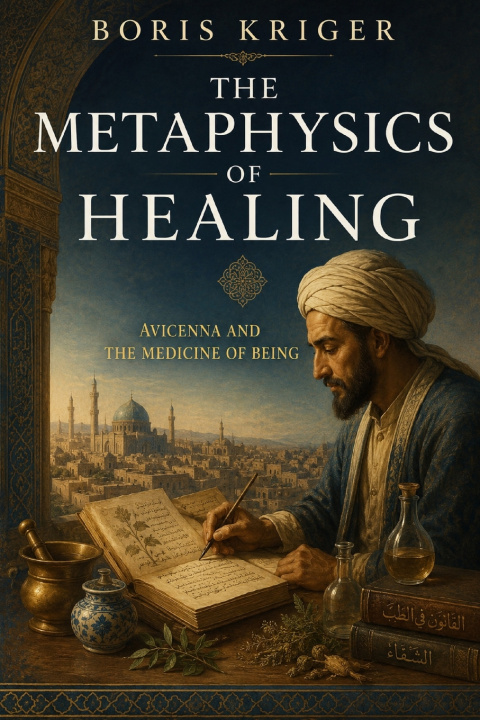
The greatest physician of his age wrote a masterwork he called The Cure, and put no medicine in it. Avicenna's Book of Healing is not a manual of remedies but a work of metaphysics, an attempt to cure the deepest sickness of all: the soul's ignorance of what it means to be. This book follows that single, startling idea across the whole arc of an extraordinary life.
Here is the boy who memorized the entire Qur'an before most children learn to read, the seventeen-year-old summoned to heal a king, the vizier who wrote fifty pages a night while armies gathered outside the walls. And here, threaded through the story of his cures and his exiles, is his real ambition: to show that health is order and illness is disorder, whether in a fevered body, a grieving mind, or a cosmos misread by a confused intellect. From the balance of the humors to the distinction between what a thing is and that it is, from a man imagined falling through empty air to the borrowed light by which we think at all, Avicenna kept raising the word healing upward, from flesh to being itself.
Written for curious readers rather than specialists, and carrying no equations, this is a book about a doctor who decided that the most important patient was existence, and about a question that has quietly outlived him. In an age of scans, protocols, and tireless machines that never forget a chart, who is left to heal the ignorance of the soul?
KEYWORDS
Avicenna, metaphysics, healing, medicine, soul, existence, Islamic philosophy