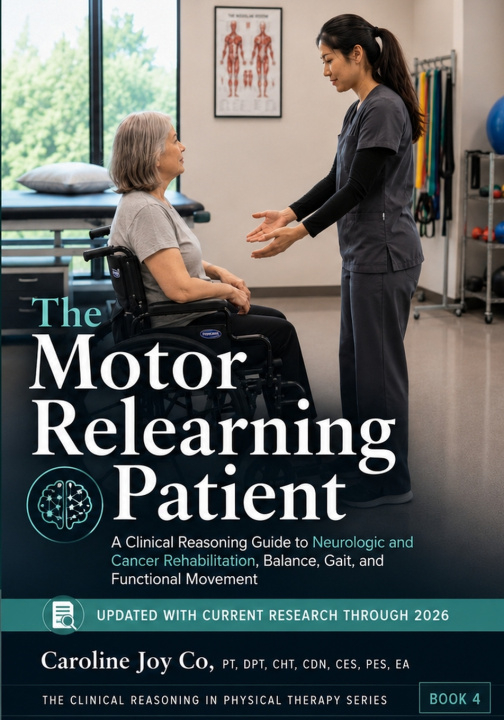
Motor relearning is not only a neurologic concept. It is the work of helping patients move again when movement has become unsafe, inefficient, uncertain, or no longer automatic.
The Motor Relearning Patient is a practical clinical reasoning guide for physical therapists, students, and rehabilitation clinicians working with patients who present with complex movement problems across neurologic and oncology rehabilitation.
Written from the perspective of a practicing physical therapist, this book connects motor relearning principles to real clinical decisions: how to observe movement, identify compensations, choose meaningful tasks, adjust cueing, progress balance and gait, and support functional recovery when weakness, sensory change, fatigue, deconditioning, pain, fear, or medical complexity affects performance.
Rather than offering a rigid protocol, this guide helps clinicians think through the patient in front of them.
Inside, readers will find a practical framework for applying motor relearning to:
- Neurologic rehabilitation
- Cancer rehabilitation and survivorship
- Balance and fall risk
- Gait training and functional mobility
- Transfers and transitional movements
- Sensory change, fatigue, weakness, and deconditioning
- Home programs and real-world carryover
- Complex cases where recovery is nonlinear
Updated with current research through 2026, The Motor Relearning Patient emphasizes evidence-informed care while acknowledging the limits of the research when applied to medically complex patients. It is written for clinicians who want to move beyond exercise lists and toward more thoughtful, task-specific, patient-centered rehabilitation.
This is Book 4 in The Clinical Reasoning in Physical Therapy Series.