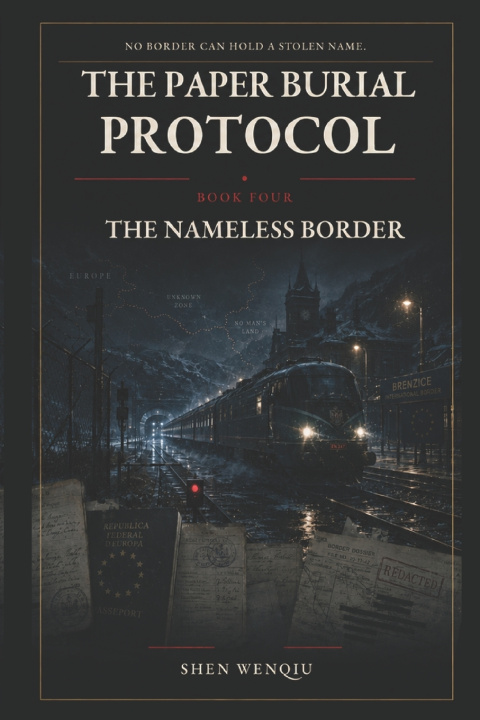
A night train enters an Alpine tunnel carrying 312 passengers.
Minutes later, every connected system reports the same result:
Valid passengers: zero.
The train has not vanished. Its weight, heat, power consumption, and human voices are still detectable. But the passengers' identities have been placed under continuity review, severing their access to bank accounts, medical authority, family rights, property, corporate votes, border crossings, and the courts. No agency has declared them dead. Each institution has simply decided, for the moment, not to recognize them.
After the crisis in the Luzon Strait, Chou Yun-heng was sentenced to nine and a half years in prison. He was not pardoned, and stopping a larger catastrophe did not erase the crimes he had already committed. Yet when the missing train is diverted into a sealed maintenance corridor beneath the Alps, several European governments secretly remove him from custody.
On paper, Chou remains inside a high-security medical prison.
In reality, he has been classified as a necessary operational asset.
The system controlling the train uses the language of a personhood-suspension concept Chou once designed and refused to deploy. If the mission succeeds, he remains a prisoner. If it fails-or if his release becomes public-the governments involved can deny the operation and declare him an escaped convict.
The passengers were not chosen at random. Among them are landowners blocking a strategic transport corridor, union representatives opposing automation, shareholders capable of stopping a merger, engineers who know the system was illegally altered, and witnesses preparing to testify. Their identities need not disappear forever. They need only remain suspended for forty-eight hours-long enough for land, votes, contracts, testimony, and assets to move beyond recovery.
But the threat is not entirely manufactured.
One passenger is genuinely connected to a violent network and carries the authorization needed to trigger an attack on another piece of critical infrastructure. Restoring everyone immediately may give that person back the communications and financial access required to act. Extending the suspension may protect millions-but permanently strip innocent passengers of their families, property, legal standing, and right to object.
Dr. Eva Klein, architect of the Continuity Platform, believes that temporarily restricting a questionable identity is more responsible than releasing someone who could kill hundreds. Chou understands her reasoning because it mirrors his own past: he once broke the connection between bodies and names to save individuals; Eva suspends that connection to protect the public. One exploited the gaps in the system. The other tried to close them. Both believed there was no other choice.
Inside the train, frightened parents begin accepting temporary names in exchange for medical care and permission to leave. Families are divided. Passengers turn against one another. And when Chou uses incomplete information to expose the people controlling the operation, his calculation costs a life and fractures his alliance with Lin Po-chuan.
With the forty-eight-hour deadline closing, Chou is offered the fastest solution: sign a single guarantee restoring all 312 passengers under his authority.
But if he signs, their existence will once again depend on one powerful man deciding who they are.
This time, Chou cannot choose a name for everyone.
He can only fight to give each passenger enough time to speak their own.