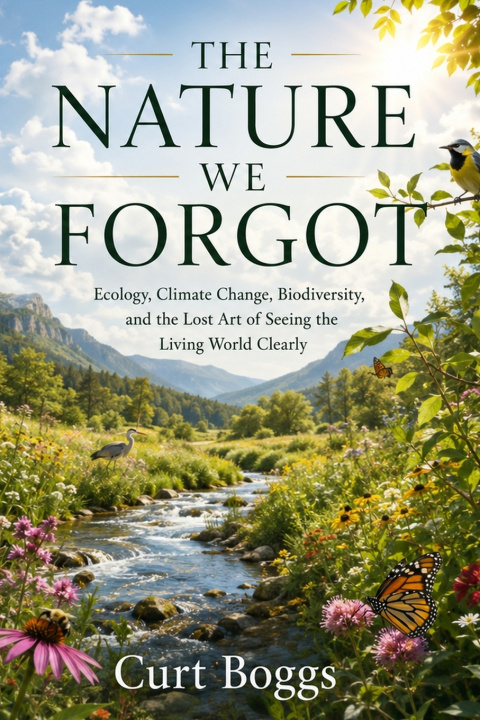
What happens when the natural world is not destroyed all at once, but quietly reduced until
loss begins to feel like normal life?
The Nature We Forgot is a luminous, urgent, and beautifully reasoned work of ecological
nonfiction for readers who sense that something vital has vanished from the air, the soil, the
seasons, and even from our language - and who want to understand it clearly enough to care
with force.
In this elegant and intellectually stirring book, Curt Boggs restores the forgotten grammar of relationship that
once allowed people to see the living world clearly. Moving from birds, fields, rivers, forests, insects, soil,
water, biodiversity, and climate into the deeper crisis of ecological memory, Boggs shows how a diminished
world can disguise itself as ordinary when no one remembers what abundance once meant.
This is not a textbook, and it is not a simple lament. It is a work of explanation, witness, and re-enchantment -
a guide for readers who want environmental writing with scientific depth, literary force, and moral clarity.
With precision and grace, The Nature We Forgot reveals why ecology is not merely the study of nature, but
the language of consequence: the way food, health, heat, species, watersheds, cities, childhood, and public
responsibility are woven into one living system.
For readers drawn to the moral intelligence of Rachel Carson, the attentiveness of Robin Wall Kimmerer, the
ecological lyricism of David George Haskell, and the urgency of contemporary climate writing, this book
offers a powerful invitation: to stop treating nature as scenery and begin seeing it as memory, infrastructure,
kinship, and obligation.
Urgent without sensationalism and beautiful without evasion, The Nature We Forgot is for anyone who has
noticed quieter summers, fewer birds, hotter seasons, thinner woods, or a strange uncertainty in the old
language of the natural world. It is a book for readers who do not want to be comforted by vagueness, but
awakened by clarity.
To remember the living world is not to retreat into nostalgia. It is to recover the vision required to protect what
remains - and to imagine what might still return.