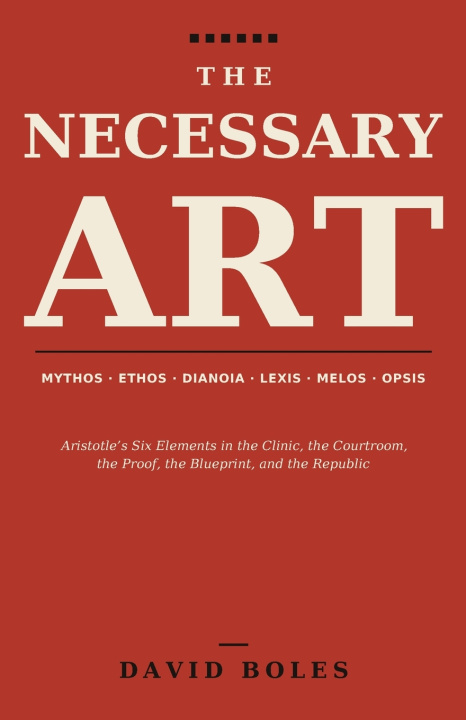
An argument for taking a stolen title back.
In 1595, in the Italian city of Padua, a medical student climbed a dark staircase and came out standing at a wooden rail, inside a funnel of carved walnut six galleries deep, every eye aimed at one lit table. The Greek word for a theater means the seeing-place, and the men at that rail knew what kind of room they were in. The anatomists knew too. They had built a theater on purpose.
For most of Western history, art meant a principled, teachable discipline of making and doing, judged by its work. The family that held the painter also held the physician, the advocate, the geometer, the builder, and the founder of a state, and Aristotle's Poetics gave them all one instrument: mythos, ethos, dianoia, lexis, melos, and opsis, six load-points where a made thing carries weight, and where it can be built sound or built rotten. Then, in 1746, a French abbé fenced the fine arts inside a single principle, the Encyclopédie drew the map, and Kant gave the wall its constitution. Inside went the realm of genius. Outside went everyone who works. David Boles calls the wall what the record shows it to be: recent, forged at the edges, and due for demolition. The wall is younger than the professions it divided.
First the book clears the record. The three unities were issued in Aristotle's name by an Italian commentator in 1570; the tragic flaw is a mistranslation of hamartia; Freytag's pyramid was practical advice published in Breslau in 1863; katharsis, used once in the treatise and never unpacked, was shrunk to a purge. Four forgeries, each with a date and a paper trail. Then the tour begins: the clinic, where a diagnosis is a recognition scene and William Harvey's seventy-two pages gave physiology its founding plot; the courtroom, where the rules of evidence stage which stories a jury may hear; the proof, where a letter from Madras made G. H. Hardy judge character before theorems; the blueprint, where Louis Kahn asked the brick what it wants; and the republic, where a constitution is a script and the two Nurembergs, the 1934 rally and the 1945 trial, show what spectacle costs and what a welded argument answers.
The Necessary Art returns the title to its holders. For every reader who makes things that must hold, and for everyone ever told their discipline does not count as art.