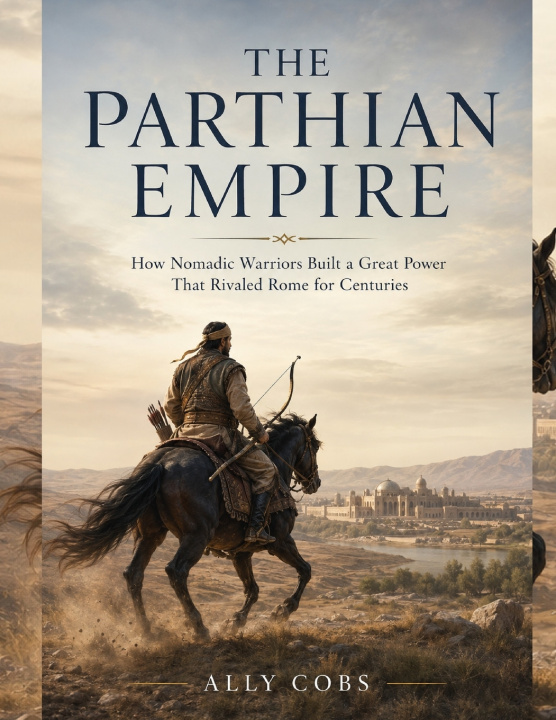
For nearly five centuries, an empire born on the fringes of the ancient world stood as equal to Rome, contested its legions on the open plains of Mesopotamia, and traded silk and spices along routes stretching all the way to Han dynasty China. Ask most people today what they know of it, and the answer is usually a shrug, or perhaps a vague memory of a Roman general meeting a grisly end at the hands of unfamiliar horsemen. It deserves far more than that.
The Parthian Empire tells the full story of the Arsacid dynasty, from its improbable origins among nomadic tribesmen on the Central Asian steppe to its collapse at the hands of a rebellious vassal king in 224 AD. Drawing on the surviving Greek, Roman, and Chinese accounts, along with the archaeological record left behind at sites like Nisa, this book traces how a small nomadic people conquered a Seleucid province, absorbed the wealthy cities of Media and Mesopotamia, and built a decentralized empire of vassal kings stretching from the Euphrates to the borders of India.
At the center of that story is Parthia's long and consequential rivalry with Rome, a conflict that began with the catastrophic Roman defeat at Carrhae and continued for more than two centuries through the campaigns of Trajan, Marcus Aurelius, and Septimius Severus. But this book looks well beyond the battlefield. It explores how Parthian kings governed an empire of extraordinary diversity, how queens and queen mothers occasionally seized genuine political power, how mounted archers perfected the tactic that still bears their name, and how Parthian religious life blended Zoroastrian tradition with Greek gods, Jewish communities, and the earliest stirrings of Christianity, eventually giving rise to a new faith, Manichaeism, that would spread across two continents.
Readers looking to understand the ancient Near East will come away with a clearer picture of how Parthia shaped the balance of power between Rome and the East, why the empire's flexible system of governance proved to be both its greatest strength and its ultimate undoing, and how much of what came after it, from Sasanian Persia to early Islamic art and architecture, carried Parthian influence forward long after the Arsacid dynasty itself had fallen.
Written for readers with little prior background in the subject, this book unfolds as a connected narrative rather than a list of dates and names, following one of history's most underappreciated empires from its uncertain beginnings on the open steppe to its final battle on a plain in southern Iran. If you have ever wondered who really stood on the other side of Rome's eastern frontier, this is where that story begins.