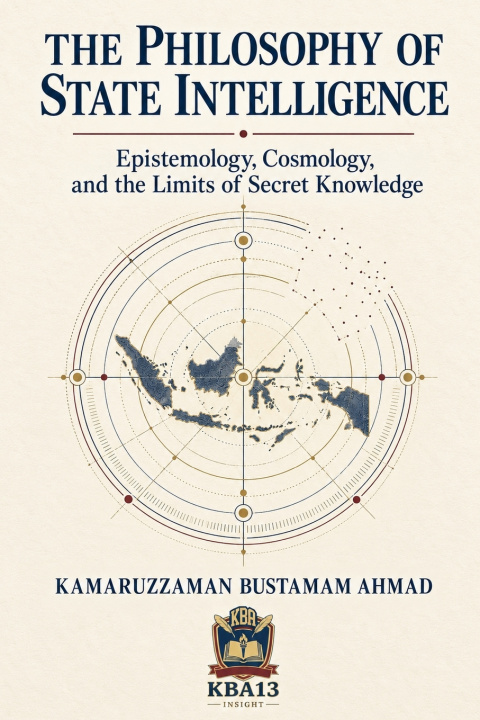
What can a state truly know-and what remains invisible because of the way it chooses to know?
Intelligence agencies are commonly understood as institutions that collect secrets, assess threats, and reduce uncertainty. Yet before any information can be gathered or analysed, a more fundamental decision has already been made: what counts as knowledge, which signs deserve attention, whose testimony is considered credible, and which dangers a state is capable of imagining.
In The Philosophy of State Intelligence, Kamaruzzaman Bustamam Ahmad approaches intelligence not merely as an operational practice, but as an epistemological institution: a system through which the state defines reality itself. Drawing on intelligence history, political philosophy, anthropology, and Southeast Asian thought, he examines the hidden assumptions that shape how governments interpret threats, legitimacy, stability, and political disorder.
The book moves across the institutional worlds of the CIA, KGB, Mossad, and Indonesian intelligence. It examines Allen Dulles and the Cold War epistemology of intelligence; Oleg Kalugin and the moral exhaustion of the Soviet security apparatus; Antonio Mendez and the government of perception; Mossad's organisational doctrine; Operation Paperclip; and the transformation of KGB networks into structures of post-Soviet power.
But the argument does not remain within the conventional geography of intelligence studies. Ahmad brings these global histories into conversation with Indonesian and Nusantara concepts of power, knowledge, and political order. Through Barus, Aceh, Java, wafak, mandala, rasa, and the intermediary figure of the wongke, the book demonstrates that non-Western intellectual traditions are not merely cultural illustrations. They can generate theoretical tools for understanding forms of authority, dissonance, and political vulnerability that modern security institutions frequently fail to perceive.
At the centre of the book is the concept of meta-intelligence: the examination of the cultural, symbolic, epistemological, and cosmological frameworks that determine what a state can recognise as knowledge. Meta-intelligence asks not only what governments do not know, but what their institutions may be structurally incapable of seeing.
Ambitious, comparative, and critically argued, The Philosophy of State Intelligence challenges the Anglophone foundations of conventional intelligence studies and advances a distinctive perspective from Indonesia and the Global South. It is essential reading for scholars and readers interested in intelligence studies, political philosophy, security institutions, anthropology, Southeast Asia, and the relationship between knowledge and state power.