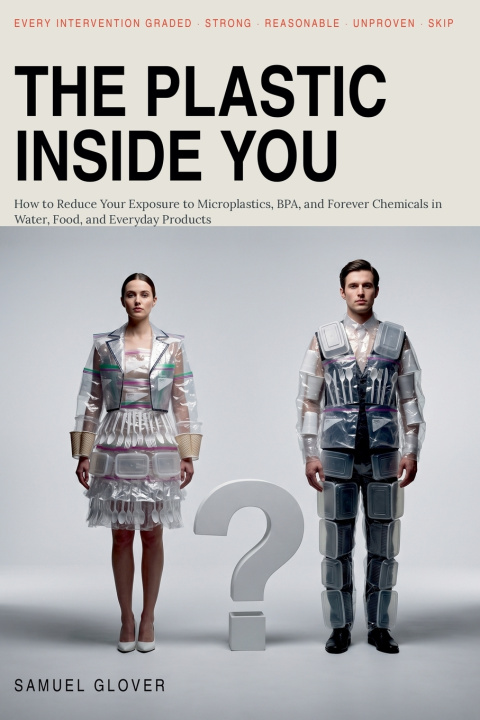
You read the headline. Then you tried to work out what you were supposed to actually do about it.
Plastic in your blood. In your lungs. In arterial plaque. Reported in placenta and in breast milk. The stories arrive every few months, each one worse than the last, and not one of them tells you whether to throw out your food containers tonight or ignore the whole thing. So you do nothing. And it sits there.
Two shelves exist for this problem. One says you are already poisoned. The other says you are already poisoned and sells you a monthly cleanse. Neither gives you a real number, because a real number would end the conversation.
This book gives you the real number where one exists and says plainly where one does not.
It opens with the study that started the panic. In March 2024, research found plastic in carotid artery plaque. Patients whose plaque contained plastic were four and a half times more likely to have a heart attack, have a stroke, or die. That is the finding that changed the temperature of this conversation. You will also read what happened afterward, when analytical chemists began arguing in print that several of the most widely reported findings may be measuring ordinary human fat rather than polyethylene. That fight is unresolved. It is in Chapter One, because you cannot judge a headline without it.
You will find out why two published estimates of how much plastic you swallow sit six orders of magnitude apart, and why the credit card a week figure you have heard everywhere is almost certainly wrong.
Then it does the part nobody else does. It grades everything.
Every intervention gets a verdict. STRONG. REASONABLE. UNPROVEN. SKIP. What the evidence supports. What is cheap enough to be worth doing anyway. What is a waste of money dressed up as caution.
Water, with a straight answer on filtration and bottled water. The heat rules, which matter more than any product you can buy. Food packaging, black plastic utensils, and the kitchen swaps that earn their cost. Household dust, indoor air, and textiles. The bathroom shelf, where phthalates and fragrance chemicals do more measurable work than particles do. And a chapter on reading labels and ingredients, so you can tell BPA, PFAS and forever chemicals apart from marketing.
There is a chapter for babies and children, and for pregnancy, written without the guilt that usually comes attached.
What you will not find: no detox. No cleanse. No binders, no supplements, no proprietary anything, and a chapter explaining exactly why each of those succeeds or fails.
This is for the reader who wants to lower chemical exposure at home and get on with their life. Who wants a less toxic house, not a personality built around one. Who has noticed that the loudest voices on microplastics, plastic toxins and endocrine disruptors all seem to be selling something.
The particle question is genuinely open. The chemical question is further along, and it is not in plastic's favor. Holding those two apart is the whole book. It is also the reason your reasonable next step is smaller, cheaper and far less frightening than the headlines implied.