When a taper goes wrong, the chart usually records a relapse.
A patient reduces their antidepressant, destabilises three weeks later, and returns to the original dose. They improve within four days. That improvement gets documented as confirmation that the medication was still needed. But recovery in four days is not how a depressive relapse behaves. It is how withdrawal behaves when the drug is restored, and the reasoning required to tell the difference is taught in almost no prescribing program.
What this book does
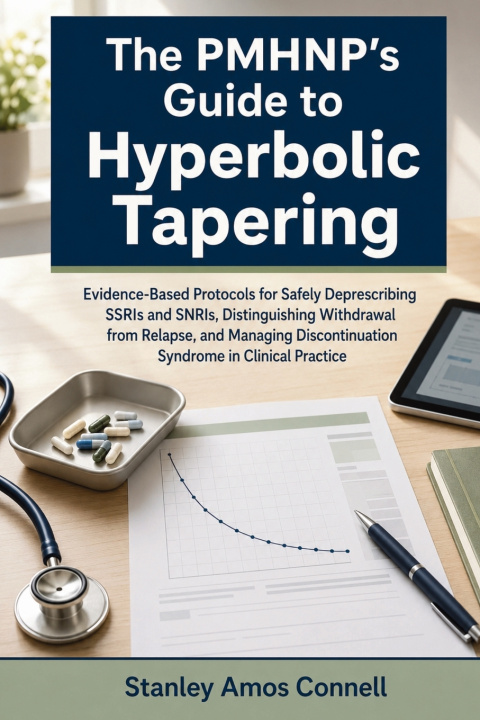
Hyperbolic tapering is now recommended in national clinical guidance, and knowing that it works does not tell a prescriber what to write on Tuesday afternoon. This book covers the part that comes after the theory: how to generate a proportional schedule from any starting dose, how to distinguish withdrawal from relapse in a fifteen minute follow up, where to obtain doses that no manufacturer produces, how to work with a compounding pharmacy, when to hold rather than reverse, and what a defensible chart note contains.
Why this book is different
Most tapering references are written for a mixed clinical audience and assume a formulary that does not match United States practice. This one is written for a single profession and a single supply chain. It teaches a method that generates schedules rather than supplying tables to copy, because the patients who most need help are the ones whose dose, drug, and history appear in nobody's table. It also treats the current scientific disagreement about withdrawal seriously rather than picking a side, so that a clinician can answer the patient who arrives with a conflicting headline.
Who this is for
This book is for readers who prescribe antidepressants and were never taught how to stop them. It will suit psychiatric mental health nurse practitioners in independent, telehealth, or small group practice; nurse practitioner students working through a psychopharmacology sequence; physician associates and family practitioners managing long term antidepressant use in primary care; and clinical preceptors who supervise prescribing.
A practical foundation
Sixteen chapters take the reader from the receptor pharmacology through patient selection, informed consent, schedule arithmetic, formulation sourcing, monitoring, troubleshooting, special populations, documentation, and the practice structure required to deliver this work on a real caseload. If you want a clear and practical guide to deprescribing antidepressants in United States clinical practice, this book offers a structured place to begin.