Have you ever noticed that your date of birth is one of the few details that accompanies you throughout your entire life?
You may change your name, profession, home, friends and even the way you see the world. But the date on which you entered this world remains the same.
Numbers and the search for meaning
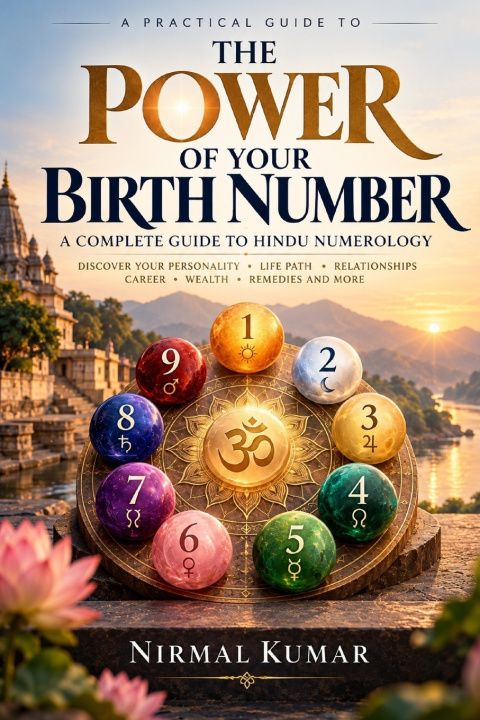
People across cultures have explored numbers through mathematics, philosophy, religion, astrology and spiritual traditions. In contemporary Indian numerology, numbers are often interpreted alongside the nine grahas-the planetary influences recognised in Jyotisha. This practice is commonly called Ank Jyotish or Indian numerology.
Your first number
Imagine that someone was born on the 23rd day of a month. In the method used throughout this book, the birth day is reduced by adding its digits: 2 + 3 = 5. The person's Mulank, or birth number, is therefore 5.
Meaning without a fixed label
In one common contemporary Indian numerology convention, 5 is associated with Budh, or Mercury, and is symbolically linked with communication, adaptability, curiosity and commercial thinking. That does not mean every person born on the 5th, 14th or 23rd will have the same personality. People are shaped by family, education, culture, opportunities, circumstances and their own decisions.
A reflective practice
Use an interpretation as a question, not a verdict. Do you enjoy variety? Do you communicate easily? Do you sometimes become restless when life feels repetitive? Which descriptions, if any, genuinely resonate with your experience? The purpose is not to place yourself in a box; it is to ask more useful questions about yourself.
What this book will teach you
You will learn to calculate your Mulank from the day of birth and your Bhagyank from the complete date of birth. You will explore the traditional planetary associations of numbers one through nine, examine how different numbers are interpreted together, and practise reading dates independently.
This book discusses contemporary Indian numerology as a traditional symbolic practice for education and personal reflection. Numerology is not a scientifically established method for predicting personality, health, wealth, relationships or future events. It is not a substitute for professional medical, legal, psychological or financial advice. Interpretations differ among schools.
A Note from the Author
This book grew from my curiosity about numbers, traditional wisdom and the many paths people take through life. I explored multiple books and perspectives, supported by extensive AI-assisted research, to bring together ideas about numerology, Hindu astrology, spirituality and personal development. My aim is to present these traditions in accessible language and encourage thoughtful self-reflection rather than fixed predictions. AI-assisted material and source claims require independent verification; readers should treat interpretations as symbolic, not proven facts. - Nirmal Kumar