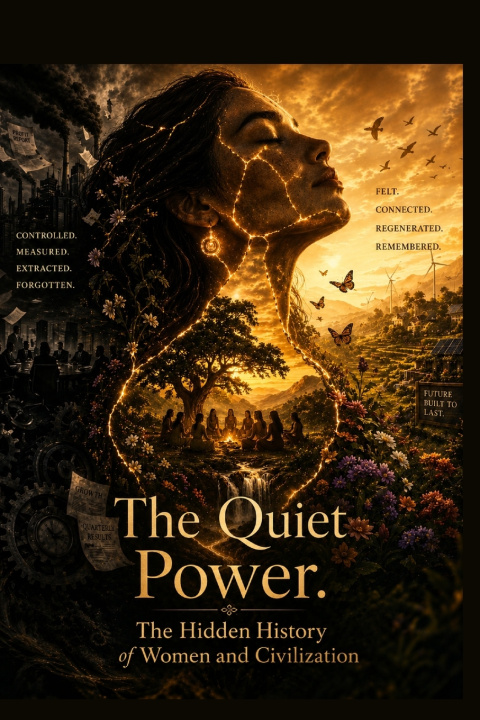
This book offers a bold reinterpretation of human history: that women did not slowly gain power over time, they had it, lived it, and then lost it.
Much like enslaved people who once knew freedom before systems of domination were imposed, women's story is not one of absence, but of displacement.
There was a time when power was not held through domination, but through presence, woven into the fabric of everyday life.
In early human societies, organized around small, interdependent communities, women were central to survival and continuity. They were life-givers, knowledge keepers, healers, and anchors of social cohesion.
Influence did not require permission; it was inherent. Power, in this world, was not hierarchical, it was relational.
The shift came with scale. As human groups expanded into cities, complexity demanded coordination, and coordination opened the door to control.
With the rise of organized warfare, power began to consolidate.
War became both the mechanism and the justification for a new order, one where physical strength, territorial defense, and command structures redefined leadership.
In this transition, men did not simply "take" power arbitrarily; they claimed it under the necessity of protection and survival.
But in doing so, they reshaped power into something narrower, something that could be owned, measured, and enforced. And in that reshaping, women's power, subtle, distributed, and embedded was pushed to the margins.
By the early 20th century, this transformation had reached its peak.
Industrialization drew people into cities, dissolving the intimate networks where women's influence had once thrived. Institutions replaced communities. Authority became formal, centralized, and overwhelmingly male.
It is here that rebellion begins, not as a rise, but as a remembering.
The fight for suffrage is often framed as the birth of women's political power.
But this book reframes it as a response to exclusion from newly created systems.
In a village, where influence was direct and lived, the right to vote was almost irrelevant. But in large, impersonal societies, where decisions were made far from daily life, formal representation became essential.
Women were not asking for power, they were asking for access to systems that had redefined it. Through protests, movements, and gradual integration into institutions, women began to reclaim space.
But the deeper question remained.
Were they gaining power, or adapting to a version of power that was never originally theirs?
This book challenges the reader to reconsider the arc of history:
What if women's power was not something to be achieved, but something that was always present, only obscured by systems built around war, scale, and control?
What if the modern era is not witnessing the rise of women, but the re-emergence of a form of leadership humanity once depended on?
And if that is true, then the future may not belong to those who dominate, but to those who remember how to hold power without taking it.