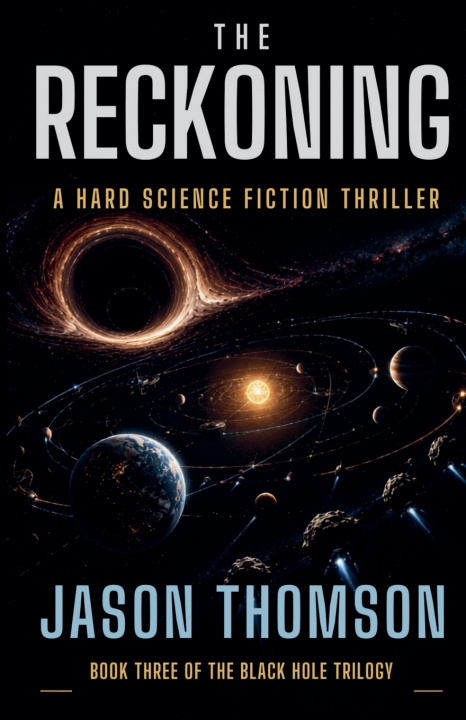
In 2188 they found the thing that was coming. In 2199 it arrives.
A black hole with the mass of a small moon, falling in from interstellar space on a track that carries it through the inner solar system on the ninth of November 2199. It cannot be destroyed. It cannot be blown off course. It can only be pulled, very slightly, by putting other things in the right place first.
So they moved the asteroids.
For eleven years the programme has been landing engines on rock across the inner system. Eighty eight drivers. Fourteen bodies. Nineteen basins nudged by a few centimetres a second each, so that the sum of all that mass will bend the object's track by a fraction of a degree before it reaches the space Earth will be occupying.
It is the largest thing the species has ever attempted, and almost nobody outside the programme understands what it actually buys.
Here is what it buys. Three and a half minutes.
The margin is three point six, with an uncertainty of two point one either side of it. Nobody can improve those numbers. There is no second attempt, no test, no rehearsal. The last command left Cranesbill Three on the twelfth of September, and it takes ninety six minutes to arrive, and after that every human being alive is a spectator.
Naomi Ingram measures. Everything reaches her late, so she will spend the final day watching an event that finished before she saw it begin.
Ines Bettencourt owns the margin and has carried it since June without once being able to make it larger.
Teodora Sabau runs the fleet and the crews. She signed the order that put the last command set on the body before the one ahead of it had confirmed, because the windows gave her no other order to sign.
Ruben Ostrander built the drivers, and knows exactly which of them he would not certify again.
August Merrow signs off on the process, and lives with three names that came off a job where nobody did anything wrong.
That is the hardest thing about this programme. Nobody makes a mistake. People die anyway. And the error sitting at the centre of the whole eleven years was made in 2194 by someone doing careful work with a number that had quietly stopped being true, and nobody noticed, because nothing about it looked like a mistake.
On the ninth of November the object comes through. The measurement takes ten hours to arrive and thirty nine thousand years to settle. What the programme leaves behind is a column with no heading above it: a quantity, an uncertainty beside it, and nothing anywhere on the page telling anyone what to think.
They will not know if it worked. They do it anyway.
THE RECKONING is the final volume of The Black Hole Trilogy, and is written to stand on its own. For readers who want their science fiction load bearing: real orbital mechanics, real engineering, real institutions under real time pressure, and not a single villain in the whole book.