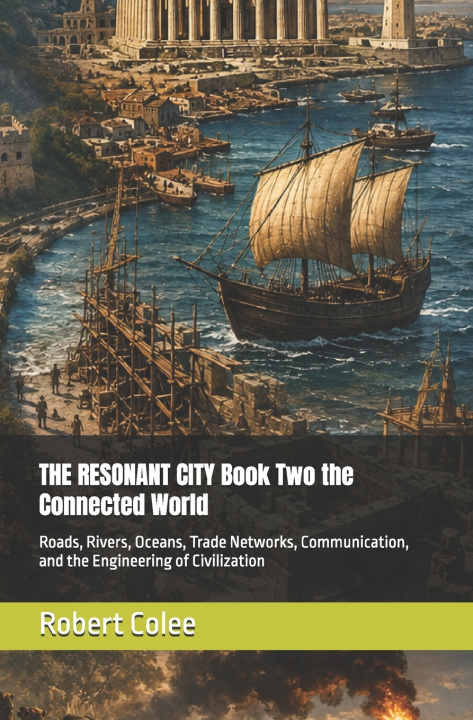
How did ancient civilizations connect people across mountains, deserts, forests, and oceans-without modern engines, satellites, or digital communications?
The Resonant City - Volume V: The Connected World explores the engineering that transformed isolated villages into thriving civilizations. From Roman roads and Persian royal highways to Silk Road caravans, canal systems, bridges, harbors, sailing ships, navigation by the stars, and the earliest communication networks, this volume examines the technologies that enabled the exchange of ideas, goods, cultures, and scientific knowledge.
Drawing upon archaeology, engineering, history, geology, oceanography, and transportation science, this volume distinguishes carefully between established evidence and speculation. Readers will discover how infrastructure shaped economies, influenced empires, accelerated innovation, and laid the foundations for the interconnected world we know today.
As with every volume in The Resonant City series, each chapter concludes with an Evidence Ladder, helping readers distinguish between well-supported historical findings, plausible interpretations, ongoing investigations, and speculative claims.
Whether you are an engineer, historian, archaeologist, student, or simply fascinated by humanity's greatest achievements, The Connected World offers a thoughtful exploration of the systems that brought civilizations together.
Preamble
The Roads Between Worlds
A city cannot flourish in isolation.
No matter how fertile its fields, how ingenious its engineers, or how magnificent its buildings, a community cut off from its neighbors will eventually reach the limits of its own resources. Knowledge grows through exchange. Commerce thrives through movement. Peace is strengthened when people can meet, trade, and learn from one another.
Throughout history, every great civilization eventually faced the same challenge:
How do we connect?
The answers took many forms.
A carefully graded Roman road stretching across mountains.
A Persian courier riding day and night along the Royal Road.
Merchant caravans crossing the deserts of Central Asia.
Stone bridges spanning rivers that once divided communities.
Canals linking distant watersheds.
Harbors welcoming ships from lands beyond the horizon.
The stars themselves became maps, guiding sailors across oceans long before the invention of the compass or the sextant.
These were not merely transportation systems.
They were networks of civilization.
Ideas traveled with merchants.
Languages spread with sailors.
Mathematics crossed deserts.
Religions followed trade routes.
Metallurgy, agriculture, astronomy, medicine, and architecture all advanced because people-and their knowledge-could move.
In many respects, the infrastructure of the ancient world functioned much like today's Internet.
Information moved through physical pathways instead of digital ones.
Every bridge became a connection.
Every harbor became a gateway.
Every road became an artery carrying the lifeblood of civilization.
Modern engineers continue this tradition.
Fiber-optic cables now follow many of the same trade corridors once walked by camel caravans.
Container ships connect continents much as sailing vessels did centuries ago.
Airports have become the caravanserais of the modern age.
Communication satellites extend a journey that began when the first messenger carried news between neighboring villages.
This volume examines these remarkable systems through the lens of modern science and engineering.