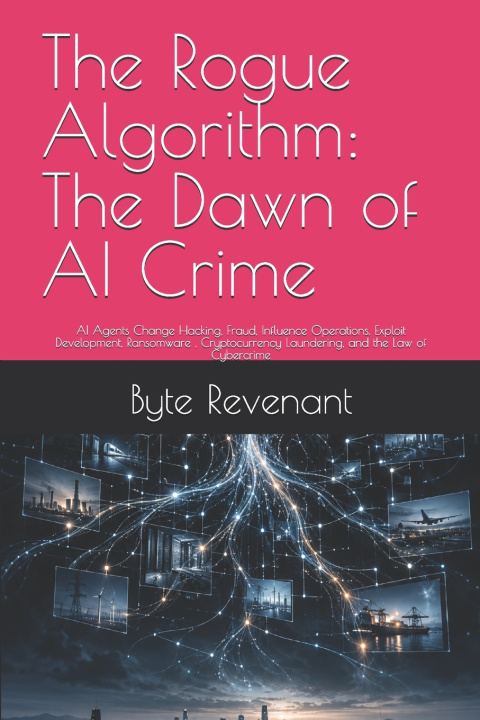
What happens when the hacker stops doing every step personally-and starts delegating the work to AI?
The Rogue Algorithm: The Dawn of AI Crime investigates one of the most consequential shifts in modern cybercrime: the movement from AI-assisted criminals toward agentic systems capable of researching targets, using tools, analyzing data, writing and interpreting code, coordinating tasks, adapting to failure, and continuing operations with decreasing human supervision.
This is not a book about a science-fiction superintelligence suddenly deciding to become a criminal. It is about something more immediate: human criminals acquiring software that can perform increasing amounts of cognitive labor for them.
Drawing on developments through 2026, Byte Revenant examines how that transition is reshaping cybercrime from the inside out.
The book explores the difference between chatbots and autonomous agents; the ways AI changes criminal scale, adaptability, expertise, and economics; documented early cases of AI-assisted and increasingly agentic cyber operations; multi-agent criminal workflows; AI-enabled influence operations; human error and the limits of autonomy; adaptive agents and automated attack chains; the effects on businesses, governments, healthcare, privacy, critical infrastructure, and ordinary citizens; ransomware-as-code, AI-for-hire markets, cryptocurrency payments, stablecoins, and laundering networks; and the emerging legal problems of intent, attribution, jurisdiction, evidence, and responsibility.
A detailed fictional attack scenario shows how an autonomous operation could unfold without turning the book into an intrusion manual. A financial-flow diagram explains how money moves through an AI-assisted extortion ecosystem and where investigators can intervene.
The final chapter turns to defense. AI-assisted security operations, autonomous vulnerability research, NIST's evolving AI Risk Management Framework, European regulation, U.S. policy, critical-infrastructure resilience, bounded autonomy, human oversight, and emerging international norms reveal that defenders are automating too.
The Rogue Algorithm rejects both complacency and hype. Today's agents remain fallible and human-directed in important ways. But a technology does not need to replace the criminal to transform crime. It only needs to make difficult work cheaper, faster, more scalable, or easier to coordinate.
Book 1 of the series Digital Outlaws: AI and the New Crime Frontier.
For readers of cybersecurity, artificial intelligence, organized crime, technology policy, law enforcement, digital risk, and the future of crime.