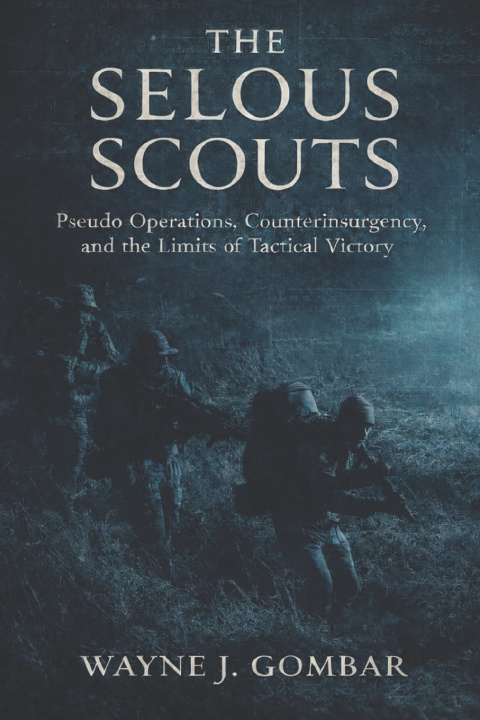
War is often remembered in victories and defeats. Far less often is it remembered in paradox.
The Selous Scouts were one of the most effective and controversial counterinsurgency units of the twentieth century. Operating in the shadows of the Rhodesian Bush War, they pioneered a form of warfare that blurred the boundaries between intelligence and combat, identity and deception, success and consequence. Through deep infiltration, pseudo operations, and unmatched small-unit autonomy, they achieved tactical results that few military organizations have ever replicated.
Yet their story does not end in victory.
This book presents a comprehensive, academically grounded examination of the Selous Scouts-from their formation under Ronald Francis Reid-Daly to their operational peak and ultimate disbandment following the Lancaster House Agreement. Drawing on military history, counterinsurgency theory, and ethical analysis, it explores not only how the Scouts fought, but what their methods reveal about the nature of modern conflict.
Through detailed case studies, doctrinal reconstruction, and comparative analysis with global special operations forces, this work confronts the central question at the heart of irregular warfare:
Can tactical brilliance overcome strategic reality?
The answer, as this book demonstrates, is far more complex than success or failure.
This is not simply a history of a unit-it is a study of warfare at its limits, where innovation collides with legitimacy, and where the battlefield is shaped as much by perception as by firepower.
Wayne J. Gombar is a doctoral-level researcher, federal executive, and subject-matter expert in critical infrastructure, counterinsurgency environments, and strategic systems analysis. He currently serves as Vice President of Critical Infrastructure at a federal solutions firm, where he leads complex programs supporting U.S. government agencies across security, communications, and operational resilience domains.
A veteran of high-level federal contracting and mission execution environments, Gombar's professional work spans telecommunications infrastructure, security systems, and emerging technologies including drone operations and counter-unmanned aerial systems (C-UAS). His experience places him at the intersection of real-world operational demands and strategic planning at the national level.
Academically, Gombar is a doctoral candidate in criminal justice, specializing in the study of how systems-both physical and digital-shape human behavior. His research explores themes such as algorithmic amplification, radicalization pathways, and the construction of criminogenic environments, blending criminological theory with modern technological realities.
He is also the author of multiple works examining warfare, intelligence, and historical power structures, with a particular focus on the human and strategic dimensions of conflict.
In this volume, Gombar brings together operational insight and academic rigor to analyze one of the most complex and controversial counterinsurgency units in modern history-the Selous Scouts-through a lens that bridges battlefield effectiveness and strategic reality.