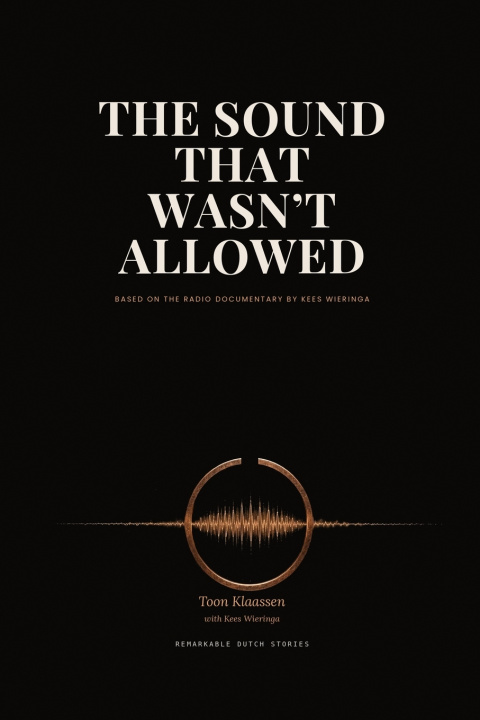
Deluxe coffee table edition: the true story of a Dutch radio engineer who invented a sound system that let people hear what they had never heard before. Colleagues called it nonsense. A world-famous conductor was stunned. His broadcaster pulled the plug. Twenty years later, it is still being passed on.
Hilversum, the Netherlands, 2003. Late one night a radio documentary tells the story of Henri van der Heide, an engineer at the sound laboratory of the Dutch public broadcasters and the man regarded as the founding father of FM stereo in the Netherlands. In the 1980s his eldest son built a headphone amplifier with carbon resistors and a carbon cable, and it sounded different: wider, deeper, more alive. Van der Heide went looking for the reason and found carbon. According to him, that material carried something a signal was never supposed to carry: ordering information, a trace of the space and the people in it. And the human body responded to it, whether the meters showed it or not.
What followed was a search that led from the measuring bench to the pendulum, from a Japanese cable to copper rings laid out on the floor of a church, from a world-famous conductor who compared the sound to crystal-clear mountain water to colleagues who called it complete nonsense. The Dutch broadcasting company he worked for built an entire recording chain around his invention, including an outside-broadcast van. Then the management forbade any further demonstrations. A patent was granted, in the Netherlands, Australia and the United States, and after that came silence.
Then the story turns darker. Copper rings on a power cable that changed the sound of an entire broadcasting center, and made the man who laid them ill. An inventor who warned that every transmitter, down to the phone in your pocket, sends out more than a signal. A well-known audio designer who said, on the record, that with this technology a whole population could be influenced through radio and television. Whether any of it is true, no one in this book can prove. But the people who were there believed it, and some of them still do.
Musician and program maker Kees Wieringa went to investigate and made a two-part documentary about it for the Humanist Broadcasting Foundation: Geluid dat niet mag, the sound that wasn't allowed. This book is the first English edition of that story. It retells the documentary word for word, in the voices of the engineers, the skeptics, the believers and Van der Heide himself, and places it in the world it came from, right up to the internet forums where audiophiles still argue about carbon today.
Inside this deluxe coffee table edition
- The complete documentary in English, chapter by chapter, with the original interviews
- The story behind the story: who Van der Heide was and what happened after the broadcast
- The patents in full, reproduced as facsimile, and Van der Heide's own 1999 article, translated into English
- A timeline, a who's who, a glossary, and a foreword by Kees Wieringa
- Large-format hardcover, premium color printing, photographs and atmospheric illustrations throughout
Who this book is for
Readers of narrative nonfiction and true stories from the edge of science, told exactly as it happened. Audiophiles and hi-fi enthusiasts who have ever wondered why two amplifiers that measure the same can sound so different. Anyone who suspects there is more to this world than what can be measured, and anyone who has ever heard something they could not explain.
This is not a book that proves, and not a book that debunks. It is a book that listens. The skeptics have their say, and so do the believers. What really happened in that laboratory, you may weigh for yourself.
Open the book, and hear the sound that wasn't allowed.